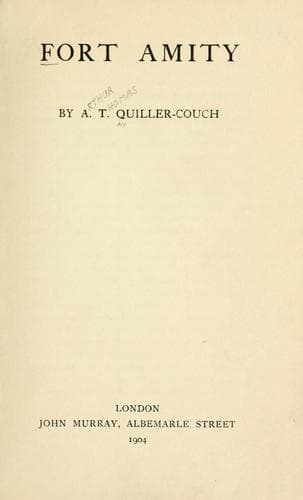
United States -- History -- French and Indian War, 1754-1763 -- Fiction
All through December the snow had fallen almost incessantly; and
almost incessantly, through the short hours of daylight, the American
riflemen, from their lodgings in the suburbs close under the walls,
had kept up a fire on the British defenders of Quebec. For the
assailants of Great Britain now were her own children; and the man
who led them was a British subject still, and but three years ago had
been a British officer.
Men see their duty by different lights, but Richard Montgomery had
always seen his clearly. He had left the British Army for sufficient
cause; had sought America, and married an American wife. He served
the cause of political freedom now, and meant to serve it so as to
win an imperishable name. The man whom King George had left for ten
years a captain had been promoted by Congress Brigadier-General at a
stroke. It recognised the greatness of which his own soul had always
assured him. "Come what will," he had promised his young wife at
parting, "you shall never be ashamed of me." His men adored him for
his enthusiasm, his high and almost boyish courage, his dash, his
bright self-confidence.
And his campaign had been a triumph. Ticonderoga and Crown Point had
fallen before him. He had swept down the Richelieu, capturing St.
John's, Chambly, Sorel. Montreal had capitulated without a blow.
And so success had swept him on to the cliffs of Quebec--there to
dash itself and fail as a spent wave.
He would not acknowledge this; not though smallpox had broken out
among his troops and they, remembering that their term of service
was all but expired, began to talk of home; not though his guns,
mounted on frozen mounds, had utterly failed to batter a way into the
city. As a subaltern he had idolised Wolfe, and here on the ground
of Wolfe's triumphant stroke he still dreamed of rivalling it.
In Quebec a cautious phlegmatic British General sat and waited,
keeping, as the moonless nights drew on, his officers ready against
surprise. For a week they had slept in their clothes and with their
arms beside them.
From the lower town of Quebec a road, altered since beyond
recognition, ran along the base of Cape Diamond between the cliff and
the river. As it climbed it narrowed to a mere defile, known as
Pres-de-Ville, having the scarped rock on one hand and on the other a
precipice dropping almost to the water's edge. Across this defile
the British had drawn a palisade and built, on the edge of the pass
above, a small three-pounder battery, with a _hangar_ in its rear to
shelter the defenders.
Public-domain text, read in full here on John Shaqi.
Reviews
Reviews
No reviews yet
Be the first to share your thoughts on this work.
Elsewhere in the archive
Join the Discussion
Join the discussion
Sign in to leave a comment or review.
Sign InorCreate an account