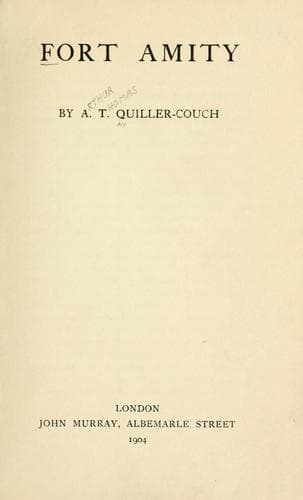
United States -- History -- French and Indian War, 1754-1763 -- Fiction
"And yet he fought in the end against his country."
"He believed that he did right."
"Should _you_ have believed it right?"
John was silent.
"John!"
He gave a start at the sound of his name and she smiled faintly.
"I have learnt to say it in English, you see."
"Do not mock me, mademoiselle! Fifteen years--"
"That is just what I was going to say. Fifteen years is a very long
time--and--and it has not been easy for me, John. I do not think I
can do without you any longer."
So in the street, under the dawn, they kissed for the first time.
EPILOGUE.
I.
HUDSON RIVER.
"Il reviendra-z a Paques,
Ou--a la Trinite!"
On a summer's afternoon of the year 1818, in the deep veranda of a
house terraced high above the Hudson, a small company stood
expectant. Schuylers and Livingstones were there, with others of the
great patroon families; one or two in complete black, and all wearing
some badge of mourning. Some were young, others well advanced in
middle life; but amidst them, and a little apart, reclined a lady to
whose story the oldest had listened in his childhood.
She lay back in an invalid chair, with her face set toward the noble
river sweeping into view around the base of a wooded bluff, and
toward the line of its course beyond, where its hidden waters
furrowed the forests to the northward and divided hill from hill.
Yet to her eyes the landscape was but a blur, and she saw it only in
memory.
For forty-three years she had worn black and a widow's goffered cap.
The hair beneath it was thin now, and her body frail and very far on
its decline to the grave. On the table at her elbow lay a letter
beside a small field-glass, towards which, once and again, she
stretched out a hand.
"It is heavy for you, aunt," said her favourite grand-niece, who
stood at the back of her chair--a beautiful girl in a white frock,
high-waisted and tied with a broad, black sash. "We will tell you
when they come in sight."
"I know, my dear; I know. It was only to make sure."
"But you tried yesterday, and with the glass your sight was as good
as mine, almost."
"Even so short a while makes a difference, now. You cannot
understand that, Janet; you will, some day."
"We will tell you," the girl repeated, "as soon as ever they come in
sight; perhaps before. We may see the smoke first between the trees,
you know."
"Ay," the old lady answered, and added, "There was no such thing in
those days." Her hand went out toward the field-glass again, and
rested, trembling a little, on the edge of the table. "I thought--
yesterday--that the trees had grown a good deal. They have closed
in, and the river is narrower; or perhaps it looks narrower, through
a glass."
The men at the far end of the veranda, who had been talking apart
while they scanned the upper bends of the river, lowered their voices
suddenly. They had heard a throbbing sound to the northward; either
the beat of a drum or the panting stroke of a steamboat's paddles.
Public-domain text, read in full here on John Shaqi.
Reviews
Reviews
No reviews yet
Be the first to share your thoughts on this work.
Elsewhere in the archive
Join the Discussion
Join the discussion
Sign in to leave a comment or review.
Sign InorCreate an account