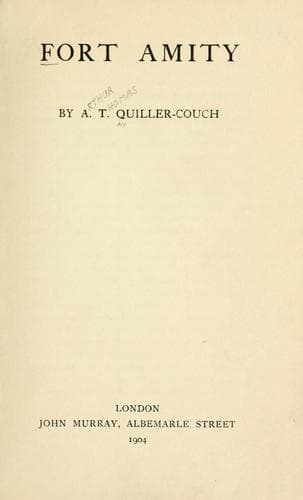
United States -- History -- French and Indian War, 1754-1763 -- Fiction
"Menehwehna, this lying cannot go on! Make you for this fort they
talk of; tell your tale there and push on to join your tribe.
Let us fix a length of time, enough for your travel beyond reach, and
at the end of it I will speak."
"And what will my brother tell them?"
"The truth--that I am no Frenchman but an English prisoner."
"It is weakness makes you lose patience," answered Menehwehna,
as one might soothe a child. "Let the weak listen to the strong.
All things I have contrived, and will contrive; there is no danger,
and will be none."
John groaned. How could he explain that he abhorred this lying?
Worse--how could he explain that he loathed Menehwehna's company and
could not be friends with him as of old; that something in his blood,
something deep and ineradicable as the difference between white man
and red man, cried out upon the sergeant's murder? How could he make
this clear? Menehwehna--who had preserved his life, nursed him,
toiled for him cheerfully, borne with him patiently--would understand
only that all these pains had been spent upon an ingrate.
John tugged away from the bond of guilt only to tighten this other
yet more hateful bond of gratitude. He must sever them both, and in
one way only could this be done. He and Menehwehna must part.
"I do not fear to be a prisoner. Moreover, it will not be for long.
The river leads, after all, to Quebec; and the English, if they take
Louisbourg, will quickly push up that way."
"The White-coat used to speak wisdom once in a while," answered
Menehwehna gravely. "'It is a great battle,' he said, 'that battle
of If; only it has the misfortune never to be fought.' Take heart,
brother, and come with me to the Isles du Castor. When your
countrymen take Quebec you shall return to them, if you still have
the mind, and I will swear that we held you captive. But to tell
this needless tale is a sick man's folly."
John could not meet the Indian's eyes, full as they were of a
wondering simplicity. He feared they might read the truth--that his
desire to escape was dead. During Father Launoy's exhortations he
had lain, as it were, with his ear against its cold heart; had lain
secretly whispering it to awake. But it would not. The questions
and cross-questions about Douai he had answered almost inattentively.
What did it all matter?
The priest had been merely tedious. Back on Lake Champlain and on
the Richelieu, when the world of his ken, though lost, lay not far
behind him, his hope had been to escape and seek back to it; his
comfort against failure the thought that here in the north one
restful, familiar face awaited him--the face of the Church Catholic.
Now the hope and the consolation were gone together. Perhaps under
the lengthening strain some vital spring had snapped in him, or the
forests had slowly choked it, or it had died with a nerve of the
brain under Muskingon's tomahawk.
Public-domain text, read in full here on John Shaqi.
Reviews
Reviews
No reviews yet
Be the first to share your thoughts on this work.
Elsewhere in the archive
Join the Discussion
Join the discussion
Sign in to leave a comment or review.
Sign InorCreate an account