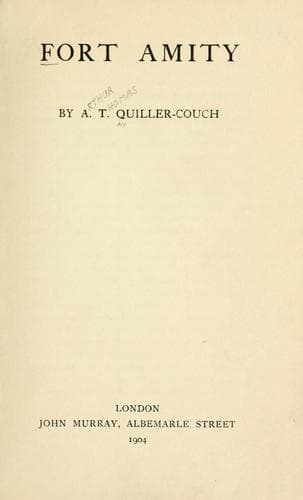
United States -- History -- French and Indian War, 1754-1763 -- Fiction
Here, if John meant to play his part, was the moment for him to
salute. He half lifted his hand as he reclined, but let it fall
again. From the river-bank a pair of eyes looked down into his; dark
grey eyes--or were they violet?--shy and yet bold, dim and yet
shining with emotion. God help him! This child--she could be little
more--was worshipping him for a hero!
"Nay, sir, give it to me!" cried the Commandant, stooping by the
quay's edge. "I shall esteem it an honour to grasp the hand of one
who comes from Fort Carillon--who was wounded for France in her hour
of victory. Your name, my friend?--for the messengers who brought
word of you yesterday had not heard it, or perhaps had forgotten."
"My name is a Cleeve, monsieur."
"A Clive? a Clive? It is unknown to me, and yet it has a good sound,
and should belong to _un homme Men ne_?" He turned inquiringly
towards his brother, a mild, elderly man with a scholar's stoop and a
face which assorted oddly with his uniform of captain of militia,
being shrivelled as parchment and snuff-dried and abstracted in
expression as though he had just lifted his eyes from a book.
"A Clive, Etienne. From what province should our friend derive?"
M. Etienne's eyes--they were, in fact, short-sighted--seemed to
search inwardly for a moment before he answered:
"There was a family of that name in the Quercy; so late, I think, as
1650. I had supposed it to be extinct. It bore arms counterpaly
argent and gules, a canton ermine--"
"My brother, sir," the Commandant interrupted, "is a famous
genealogist. Do you accept this coat-of-arms he assigns to you?"
"If M. le Commandant will excuse me--"
"Eh, eh?--an awkward question, no doubt, to put to many a young man
of family now serving with the colours?" The Commandant chuckled
knowingly. "But I have an eye, sir, for nice shades, and an ear too.
_Verbum sapienti satis_. A sergeant, they tell me--and of the
Bearnais; but until we have cured you, sir, and the active list again
claims you, you are Monsieur a Clive and my guest. We shall talk,
so, upon an easier footing. Tut-tut! I have eyes in my head, I
repeat. And this Indian of yours--how does he call himself?"
"Menehwehna, monsieur. He is an Ojibway."
"And you and he have come by way of the Wilderness? Now what puzzles
me--"
"Papa!" interposed the girl gently, laying a hand on her father's
sleeve; "ought we not to get him ashore before troubling him with all
these questions? He is suffering, I think."
"You say well, my child. A thousand pardons, sir. Here, Bedard!
Jeremie!"
Public-domain text, read in full here on John Shaqi.
Reviews
Reviews
No reviews yet
Be the first to share your thoughts on this work.
Elsewhere in the archive
Join the Discussion
Join the discussion
Sign in to leave a comment or review.
Sign InorCreate an account