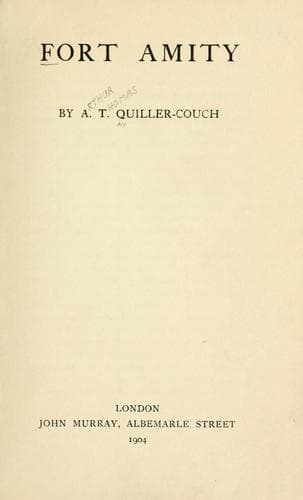
United States -- History -- French and Indian War, 1754-1763 -- Fiction
"Mademoiselle speaks in riddles. I had thought that every one of the
Commandant's household--except the Commandant himself, perhaps--was
pining to get back to Boisveyrac."
She let her needlework lie for a moment, and sat with her eyes
resting on the facade of the Commandant's quarters across the square.
"It is foolish in me," she said musingly; "for in the days of which I
am thinking not one of these stones was laid. You must know,
monsieur, that in those days many and many a young man of family took
to the woods; no laws, no edicts would restrain them; the life of the
forest seemed to pass into their blood and they could not help
themselves . . . ah, I myself understand that, sometimes!" she added,
after a pause.
"Well, monsieur," she went on, "there came to Fort Amitie a certain
young Raoul de Tilly, who suffered from this wandering fever.
The Government outlawed him in the end; but as yet his family had
hopes to reclaim him, and, being powerful in New France, they managed
to get his sentence delayed. He came here, and here he fell in love
with an Indian girl, and married her--putting, they say, a pistol at
the priest's head. The girl was a Wyandot from Lake Huron, and had
been baptised but a week before. For a year they lived together in
the Fort here; but when a child was born the husband sent her down
the river to his father's Seigniory below Three Rivers, and himself
wandered westward into the Lakes, and was never again heard of.
The mother died on the voyage, it is said; but the child--
a daughter--reached the Seigniory and was acknowledged, and lived to
marry a cousin, a de Tilly of Roc Sainte-Anne. My mother was her
grand-daughter."
Why had she chosen to tell him this story? He turned to her in some
wonder. But, for whatever reason she had told it, the truth of the
story was written in her face. Hardly could he recognise the
Mademoiselle Diane who had declaimed to him of Joan of Arc and the
glory of fighting for New France. She was gone, and in her place a
girl fronted him, a child almost, with a strange anguish in her
voice, and in her eyes the look of a wild creature trapped. She was
appealing to him. But again, why?
"I think you must be in some trouble, mademoiselle," said he,
speaking the thought that came uppermost. Something prompted him to
add, "Has it to do with Dominique Guyon?" The question seemed to
stab her. She stood up trembling, with a scared face.
"Why should you think I am troubled? What made you suppose--" she
stammered, and stopped again in confusion. "I only wanted you to
understand. Is it not much better when folks speak to one another
frankly? Something may be hidden which seems of no importance, and
yet for lack of knowing it we may misjudge utterly, may we not?"
Heaven knew that of late John had been feeling sorely enough the
torment of carrying about a secret. But to the girl's broken
utterances he held no clue at all, nor could he hit on one.
Public-domain text, read in full here on John Shaqi.
Reviews
Reviews
No reviews yet
Be the first to share your thoughts on this work.
Elsewhere in the archive
Join the Discussion
Join the discussion
Sign in to leave a comment or review.
Sign InorCreate an account