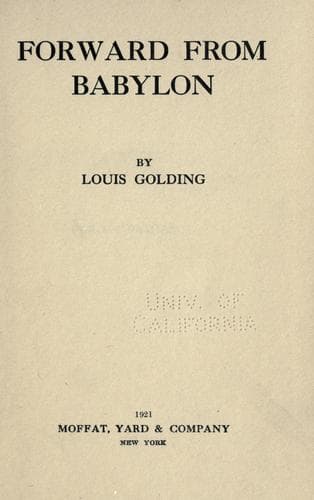
England, Northern -- Fiction; Fathers and sons -- Fiction; Jews -- Fiction
"Oh, I'm so sorry you've got to go!" she said effusively. "And I'm
awfully sorry about that too, you know! You will come round again?
Shan't he, Adolf, you'd love to see Mr. Massel again! Not at all, not
at all; oh, good night!"
On the other side of the door he remembered his translation of Dante.
"Blast Dante!" he exclaimed through his teeth.
It was the fit of profound misogyny which followed this entirely
unsatisfactory incident that fitted him so completely for the
effusiveness and glitter of Wilfrid Strauss, and for that interlude
with Kate which, only too conventional in its mere detail, was
nevertheless at once the end and the beginning of Philip Massel's
boyhood.
CHAPTER XVI
A certain hesitancy checks me upon the appearance of Wilfrid Strauss in
this narration; even though I am aware how easy and profitable it is to
philosophize upon the _deus ex machina_; how it is entertaining to
demonstrate that from the flimsiest accidentals the most stalwart
essentials depend. Yet the Wilfrid Strauss phase in Philip's
development is not so much to be considered a stalwart essential as an
exact statement of accounts, a period, a signpost whose backward arm
pointed to obscure chaos, whose forward arm pointed at least to clearer
issues, more breadth, more light. It is probable that one Strauss and
another had from time to time come into some sort of contact with
Philip, for in such communities as Whitechapel, Brownlow Hill and
Doomington, from the turbid mass of Jewish tailordom a type perpetually
emerges which is volatile, swift, scornful of the mere labour of hands,
ostentatious of the agile intellectual qualities which make the type
invaluable for undertakings rarely entirely scrupulous. If previously,
then, Philip had encountered a Strauss in embryo or in maturity, there
was no point at which their respective strengths and weaknesses had
met. Yet, in point of fact, it is Eulalie et Cie., Paris, of undefined
occupations, who have kept this particular and actual Mr. Wilfrid
Strauss too busily engaged, on the Rue de Rivoli and in Leicester
Square, for his appearance before this date in the lesser thoroughfares
of Doomington. And it is not possible to declare that Strauss, as he
swaggered gently down Transfer Street from the Inland Station, would
have met Philip Massel on any other afternoon than the May afternoon in
the year of Philip's history I have now attained.
Public-domain text, read in full here on John Shaqi.
Reviews
Reviews
No reviews yet
Be the first to share your thoughts on this work.
Elsewhere in the archive
Join the Discussion
Join the discussion
Sign in to leave a comment or review.
Sign InorCreate an account