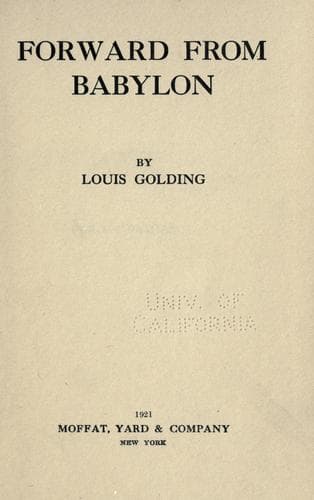
England, Northern -- Fiction; Fathers and sons -- Fiction; Jews -- Fiction
If Philip's oration on the croft, despite its immediate consequences,
had been a triumph for Philip, the fatality which had irresistibly
drawn his feet homeward after his escapade with Bertha, without any
reference to his will, was a triumph, if that was not too vulgar a
word, for Reb Monash. It made clear to both the father and the son
that Philip could not yet exist on his own initiative; however
refractory a cog he was in the machinery of the house in Angel Street,
that machinery was still the condition of his existence at all. It was
the consciousness that this position had been made starkly clear by the
issue of this latest event, and that this latest event was itself so
tangible a grievance, that induced Reb Monash to interview Mr. Furness.
After school on that same day, summoned by a special note from the
Head, Philip stood apprehensively outside his door. He knocked
timidly. A tremendous bellow filled the room and came gustily out into
the corridor.
"COME in!" the first word reduplicate and reverberant like a shout in
the cleft of hills. Philip entered, his ears singing. But the next
moment the shout ebbed wholly from his ears when he saw Mr. Furness
rise and come towards him with a smile at once admonitory and
encouraging.
"Well, Philip, how are you?"
"I'm all right, sir, thank you, sir!"
"Who is the latest poet? Still Shelley? Keep to Shelley, Philip; he
knew more of the spirit of God than all the churches!"
"I've been reading Edgar Allan Poe, sir."
"Humph! I'm not so sure! Unhealthy, morbid! Hard time, poor fellow,
on the other hand! Don't overdo him!"
"No, sir!"
"But to the matter in hand. You know why I've sent for you?"
"Yes, sir. He told me he was coming, sir."
"Your father's a great man, Philip. If in twenty years you're half the
man he is, I'll be proud of you. You've been distressing him, he tells
me. He's very concerned about you. Come now, what's wrong?"
"I can't explain, sir. We're different."
"You ran away from home lately and were out all night?"
Philip bit his lip. "Yes, sir."
"You're too old for that mock-romantic sort of thing. There's a strain
of it in your essays. Mr. Gibson sent me up your essay on Julius
Cæsar--something about 'he shall endure while the luminaries of history
rot in oblivion!' Luminaries don't rot. Leave all that to the
journalists, my boy, you can do better stuff. It wasn't only
mock-romantic, it was cruel! Can you imagine how your mother slept
that night? I'm rather ashamed of you. It was selfish. It was a
pose."
"But you don't know, sir, what had happened the day before. I was
nearly dead."
"I can understand. Public speaking, Socialism! All in their time!
You're forcing things, you'll burn out and be cinders when you ought to
be a man. No, you've not got the foundation for it. You've been
slacking in form. What is it you go to poetry for, do you know?"
"I can't say, sir. Beauty, perhaps?"
Public-domain text, read in full here on John Shaqi.
Reviews
Reviews
No reviews yet
Be the first to share your thoughts on this work.
Elsewhere in the archive
Join the Discussion
Join the discussion
Sign in to leave a comment or review.
Sign InorCreate an account