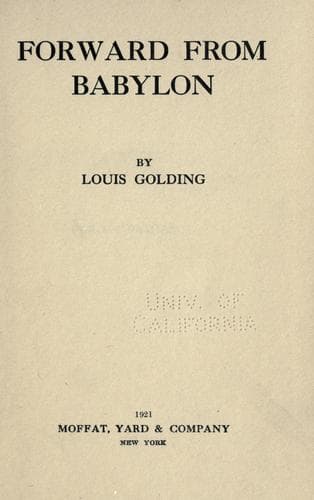
England, Northern -- Fiction; Fathers and sons -- Fiction; Jews -- Fiction
"Yes, beauty! You don't know the beauty of labour, though. When
you've mastered your Cæsar and your Greek Grammar--dull work, my boy,
dull work!--you'll find poetry finer than Shelley, the poetry Shelley
thought made his own like a marsh-lamp, the poetry of the Greeks. You
started well, but your place in form has been going down steadily.
Listen, Philip," he drew the boy nearer to him, "there's the question
of your scholarship. Think what it'll mean to her if anything happened
to your scholarship. You're not going to allow it, are you? And if
you go down as steadily as you have been going down of late, I don't
see what else can happen. What do you feel?"
There was a lump in Philip's throat. "I don't want anything to happen
which will hurt her."
"Well, Philip, we understand each other. Put your hand to the plough
like a man. Make a clean furrow and a deep one. I don't think we need
say more, need we? Come and see me when you've made a fresh discovery
in poetry, we'll talk about him. So good-bye now, Philip!"
Philip took the big man's hand and withdrew, feeling at once tearful,
chastened, and absurdly exalted, and a solemn determination now
possessed him to do some serious work before the examination which
ended the year. Every evening he withdrew to his own back room which,
out of most unpromising materials, his mother had converted into the
semblance of a study. She had inserted ledges into soap boxes where
his textbooks and poets were ranged above frills of pinky-white paper.
She had covered the doddering table with a neat piece of parti-coloured
cloth. A few bright pictures from magazines were tacked upon the
walls. In recognition of the new spirit of industry earnestly avowed
before her she substituted for the deficiently-seated chair a
rocking-chair which gave Philip an especial delight and won him to
sympathy with aorist tenses and the optative mood. Not a word passed
between Reb Monash and Philip. No current of sympathy ran to connect
them. Philip displayed no readiness to compromise in the matter of a
more ardent ritual. He would gabble off his prayers as quickly as
possible, and then, with no attempt to hide his relief, turn to his
books. His prayers were still tolerable, if barely, during the period
when he lavished his enthusiasm on active Socialism. Now that he began
to forswear his Socialistic delights, they began to be dust in his
mouth. The half-hour long morning prayers of which he might understand
one word in twenty, so wrought upon his nerves, that he felt like
crying aloud sharply, particularly during that section of the devotion
when he stood towards the East, placing together the inner sides of his
feet, looking blankly through the wall into nothingness. One morning,
during the sheer meaningless drift of his utterance, he curiously found
himself repeating something of sweet and significant import. He was
reciting, not the torpid Hebrew, but the languorous chimes of
Public-domain text, read in full here on John Shaqi.
Reviews
Reviews
No reviews yet
Be the first to share your thoughts on this work.
Elsewhere in the archive
Join the Discussion
Join the discussion
Sign in to leave a comment or review.
Sign InorCreate an account