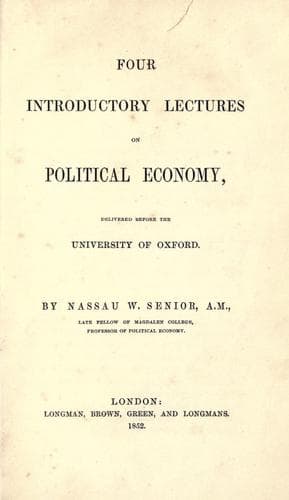
Four Introductory Lectures on Political EconomySenior, Nassau William
General
Four Introductory Lectures on Political Economy
Senior, Nassau William
Economics
If Sheridan had condescended to accept an
income on such terms, his wife’s accomplishments would have enriched
him. Subject, however, to these contingencies, personal qualities are
wealth, and wealth of the most valuable kind. The amount of the revenue
derived from their exercise in England, far exceeds the rental of all
its land.
The words wealth and value differ as substance and attribute. All those
things, and those things only, which constitute wealth, are valuable.
As the meaning of the term value has been the subject of long and eager
controversy, I shall, at a future period, consider at some length the
different significations which have been given to it. It is enough to
say at present that I use it in its popular acceptation, as signifying
in anything the quality which fits it to be given and received in
exchange, or, in other words, to be let or sold, hired or purchased.
It follows, from this definition of wealth, that in a community
enjoying perfect abundance, there would be no wealth. If every object
of desire could be procured by a wish, nothing would have value, and
nothing would be exchanged. It follows, also, that it is possible to
conceive at least a temporary diminution of the wealth of a community
occasioned by an increase of their means of enjoyment. This would be
the immediate consequence of any cause which should occasion the supply
of any useful article to change from limited to unlimited. Thus, if
the climate of England could suddenly be changed to that of Bogota,
and the warmth which we extract imperfectly and expensively from fuel
were supplied by the sun, fuel would cease to be useful, except as one
of the productive instruments employed by art. We should want no more
grates or chimney-pieces in our sitting-rooms. What had previously been
a considerable amount of property in the fixtures of houses, in stock
in trade, and materials, would become valueless. Coals would sink in
price; the most expensive mines would be abandoned; those which were
retained would afford smaller rents. The proprietors and tradesmen
specially affected by the change would lose not only in wealth, but
in the means of enjoyment. The owner of a mine whose rent fell from
20,000_l._ a year to 10,000_l._, would not be compensated by being
saved the expense of fuel in every room except his kitchen. On the
other hand, persons without fire-places or coal-cellars of their own,
would lose nothing, and the rest of the world would lose only in the
value of their grates, chimney-pieces, and stocks of coal; and all
would gain in enjoyment by being able to devote to other purposes
the money which they previously paid for artificial warmth. Still
for a time there would be less wealth. That time, indeed, would be
short; the capital and the labour previously devoted to warming our
apartments, would be diverted to the production of new commodities. The
cheapness of coal would increase the supply of manufactured articles,
Public-domain text, read in full here on John Shaqi.
Reviews
Reviews
No reviews yet
Be the first to share your thoughts on this work.
Join the Discussion
Join the discussion
Sign in to leave a comment or review.
Sign InorCreate an account