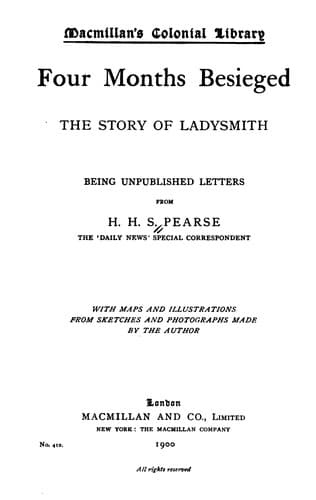
Four Months Besieged: The Story of LadysmithPearse, Henry H. S.
History
Four Months Besieged: The Story of Ladysmith
Pearse, Henry H. S.
Ladysmith (South Africa) -- History -- Siege, 1899-1900
_January 5._--Days in succession pass unbroken by any incidents
dissimilar to the routine which in the very constancy of danger becomes
monotonous. Yesterday and to-day are so much alike that one hardly
remembers which was which unless some personal adventure or a friend's
narrow escape makes a nick in the calendar. Yesterday, for instance, one
of several shells bursting about the same spot shattered the water tanks
behind a chemist's shop, and its splinters came in curious curves over
the housetops, one grazing an officer of the Imperial Light Horse, to
whom I was at that moment talking. The next shell was into the police
camp, where it burst with destructive force, completely wrecking Colonel
Dartnell's tent with all its contents, but injuring nobody. Had that
genial and most popular officer followed the almost invariable practice
of his everyday life, there would have been an end of the man to whom
more than to anybody else we owe the timely retirement from Dundee. He
it was who told General Yule, "You must go to-night or you will not be
able to go at all," and whose advice, being acted upon, brought back
several thousand men to strengthen the garrison of Ladysmith just before
its investment. The loss of such a man would have been irreparable, for
he knows more than any other officer in this country about Boers and
their methods of fighting, and he has every thread of information at
command if he were allowed to use native scouts in his own way. He would
have made the best possible chief of an Intelligence Staff, but
unfortunately military etiquette or jealousy bars his employment in that
capacity. If his advice is asked for he gives it readily as at Dundee,
and though he has no authority to act in the way that would be most
congenial to his fearless and active nature, he is as ready as ever to
render a service when wanted. Some of us know too how much civilians
have been encouraged in their endurance of a long siege by Colonel
Dartnell's cheery example. Nothing disheartens him. He is always the
same whether the day's news be good or bad, and perhaps his
unostentatious services will be adequately recognised in the end. If
they had been taken advantage of in the beginning there would be fewer
blunders to regret.
To-day Colonel Stoneman had more than one narrow escape. Two shells
burst within splinter range of the office in which he and his assistants
have worked steadily at supply details since the bombardment began. A
third passed through the roof over that office after a ricochet, and
then, without bursting, rolled to the ground in front of a stoup where
several Army Service officers were sitting. That shell will be cherished
after extraction of its fuse and melinite charge. Fire from other Boer
guns proved more disastrous. Surprise Hill's howitzer threw one shell to
the little encampment behind Range Point, where it killed one man and
wounded four of the unfortunate Royal Irish Fusiliers.
Public-domain text, read in full here on John Shaqi.
Reviews
Reviews
No reviews yet
Be the first to share your thoughts on this work.
Elsewhere in the archive
Join the Discussion
Join the discussion
Sign in to leave a comment or review.
Sign InorCreate an account