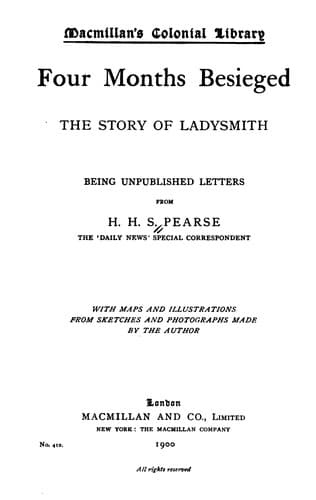
Four Months Besieged: The Story of LadysmithPearse, Henry H. S.
History
Four Months Besieged: The Story of Ladysmith
Pearse, Henry H. S.
Ladysmith (South Africa) -- History -- Siege, 1899-1900
took their places behind slight earthworks, prepared to fight it out
manfully. The only tribute they need ask for is that their roll of dead
and wounded may be borne in memory. Out of thirty all told, the Royal
Engineers lost two officers killed and fifteen men wounded. Of the few
sailors, one was killed and one wounded. This record seems hard to beat;
but the Imperial Light Horse could point to heaps of dead and maimed in
proof of the dauntless stand they made, for the living continued to
fight where their gallant comrades fell, scorning to quit an inch of
ground to the Boers, though they knew by the rifle fire flashing round
them in the darkness that they were hopelessly outnumbered from the
first. Their brigadier speaks of them as men with no nerves at all. When
one was hit, another stepped quietly up to his place and went on
shooting as if at target-practice, though he had no more cover than a
small stone to lie behind; and this happened not once but a score of
times, the officers taking an equal share in the fight with their men,
who speak with pride of the gallantry shown by Captains de Rothe and
Codrington, Lieutenants Webb, Pakeman, Adams, Campbell, and Richardson,
and the active veteran Major Doveton, who cheered his men on after he
had received two bullet wounds, one of which shattered his fore-arm and
shoulder.
By that time the sun was rising above Bulwaan in a halo of orange,
crimson, and purple, and men could count the grim faces of their
enemies. Ladysmith was aroused at dawn by the rattle of incessant rifle
fire rolling along Bester's Ridge from end to end. Up to that time no
big guns had spoken on either side, and people came out of their houses
slowly, in sulky humour at having their rest disturbed before the
conventional hour for shelling to begin. While they listened to the
continuous crackling as of damp sticks in a huge bonfire, few among them
realised that the sounds indicated anything more serious than a Boer
demonstration which would fizzle out quickly, and even when bullets
began to fall in the town itself, or went whistling away overhead, the
only comment made was that Mauser rifles must have a marvellous range if
they could send bullets so far beyond the ridge aimed at.
Bulwaan's 6-inch Creusot opened fire as the sun rose behind it in a
splendour of orange and crimson clouds. The white smoke changed to
wreaths of blue and deep purple against that glowing sky, while people
waited to hear the gurgling scream of a shell. It did not come the way
they expected, but burst above the dark crest of Caesar's Camp. Then the
watchers, relieved because the big guns had found other occupation than
battering down houses, went back to bed or to their morning baths,
little thinking that the fate of Ladysmith was at the moment dependent
on men who lay among rocks, or behind grass tussocks, looking through
rifle sights at such short range that they could almost see the colour
of each other's eyes.
Public-domain text, read in full here on John Shaqi.
Reviews
Reviews
No reviews yet
Be the first to share your thoughts on this work.
Elsewhere in the archive
Join the Discussion
Join the discussion
Sign in to leave a comment or review.
Sign InorCreate an account