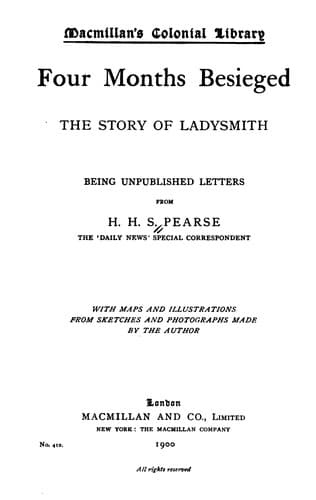
Four Months Besieged: The Story of LadysmithPearse, Henry H. S.
History
Four Months Besieged: The Story of Ladysmith
Pearse, Henry H. S.
Ladysmith (South Africa) -- History -- Siege, 1899-1900
The few bluejackets, Gordons, Imperial Light Horse, and Engineers, under
Lieutenant Digby-Jones, R.E., were still holding their ground manfully
on the extreme westerly crest of Waggon Hill. The Boers were within
point-blank range of them on two sides, while beyond the crest and down
into Bester's Valley hundreds of others were waiting for the first sign
of panic among our men to rush the position, but held in check by a
company of the 60th Rifles and a few Light Horse occupying a small
sangar on that side. The ridge, however, was being shelled by the
enemy's guns from Middle Hill and Blaauwbank with such accuracy that
many of our men were wounded by that fire, but not a Boer was hit,
though the fighting lines were less than 100 yards apart. The 21st
Battery Field Artillery, out in comparatively open ground beyond Range
Post, swept with shrapnel the slopes and kloofs of Mounted Infantry Hill
on one side, and Major Goulburn's battery, the 42nd, searched the
reverse slope of that knoll, smiting the head of a movement by which our
foes tried to strengthen their attack. The Natal artillery had done
similar service at an earlier stage against another body, and though
under heavy rifle fire they still stuck to their guns manfully. Our
naval 12-pounder mounted near this battery, but having double the range,
played upon Middle Hill, trying by rapid and accurate fire to silence
the big Creusot gun there, or baffle its aim.
This was the favourable opportunity seized by Colonel Hamilton for
sending forward Major Miller-Wallnutt with one company of Gordons to
reinforce the little group of bluejackets, Light Horse, Engineers, and
Highlanders who were fighting so desperately hard to beat the Boers
back. A little later Major Campbell reached Waggon Hill with four
companies of the "Second Sixtieth," but their fire failed to dislodge
the Boers, and the Gordons, under Miller-Wallnutt, were being sorely
pressed, the Boers having a number of picked shots among the rocks on
two sides whence they could bring a deadly fire to bear on the flanks of
any force that might attempt to cross the open ground between. General
Hamilton, however, seeing that risks must be taken, or the Gordons would
be in perilous plight, sent two companies of Rifles forward in
succession, but smitten in front by artillery fire from Middle Hill and
Blaauwbank, while their flanks were raked by rifle bullets, they halted
and took such cover as could be found among small stones. A company
being then called upon to rush the open space, Lieutenant Todd asked for
permission to try first with a small body, and this being granted he led
a mere handful of ready volunteers forward. The gallant young officer,
however, had not gone many yards before he was shot dead, and the men
fell back disheartened by the loss of one whom they would have followed
anywhere, because they recognised in him the qualities of a born leader.
Public-domain text, read in full here on John Shaqi.
Reviews
Reviews
No reviews yet
Be the first to share your thoughts on this work.
Elsewhere in the archive
Join the Discussion
Join the discussion
Sign in to leave a comment or review.
Sign InorCreate an account