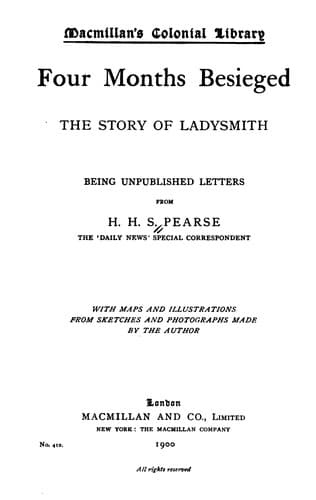
Four Months Besieged: The Story of LadysmithPearse, Henry H. S.
History
Four Months Besieged: The Story of Ladysmith
Pearse, Henry H. S.
Ladysmith (South Africa) -- History -- Siege, 1899-1900
This brilliant victory, demonstrating to the Boers the vast
difference between firing from cover on British assailants and
attempts to storm positions held in force by our troops, cost the
army at Lady smith 420 men in killed and wounded. The large
proportion slain on the spot was remarkable, and was due, no doubt,
to the close fighting. Fourteen officers were killed and 33
wounded, while the non-commissioned officers and men killed
numbered 167, and the wounded 284. The killed included, besides
Colonel Dick-Cunyngham, Major Mackworth of the 2nd Queen's;
Lieutenant Hall, Rifle Brigade; Major Miller-Wallnutt, Gordon
Highlanders; Lieutenant Digby-Jones and Lieutenant Dennis of the
Royal Engineers, all of whom met death heroically; Captains Lafone
and Field, who were shot down as they charged at the head of their
regiment; and many gallant volunteers serving in the ranks of the
Imperial Light Horse. One company of the Gordons at the close of
the battle was commanded by a lance-corporal, who was the senior
officer unwounded. The Imperial Light Horse was commanded by a
junior captain, and could only muster about 100 men fit for duty
out of nearly 500. As to the Boer losses, it is difficult to arrive
at the truth. The Boer has to be badly beaten before he will
acknowledge having suffered a reverse, and even in such cases every
endeavour is made to hide the real facts of the case, and the
acknowledgment is tardily and reluctantly offered. As supplementing
his description of the memorable struggle, we take the following
extracts from Mr. Pearse's diary:----
_January 7._--I rode to-day over the battlefield, where dead Boers still
lay unclaimed, but bearing on them cards that left no doubt about their
identity. I learn that one of that brave little band, the Imperial Light
Horse, wounded early in the fight, was tended gently by a Boer parson,
who bound up his wounds and brought him water under a terrific fire.
Struck by these acts of humanity and devotion to a high sense of duty, I
made inquiries as to the Dutch parson's name. It was Mr. Kestel, pastor
of the Dutch Reformed Church at Harrismith, a Boer only by adoption, a
Devonshire man by birth and descent.
There was to-day a solemn service of thanksgiving in the English Church.
A _Te Deum_ was impressively sung,--Sir George White and his Staff, at
the Archdeacon's invitation, standing at the altar rails,--and was
followed by "God Save the Queen."
_January 8._--Sir Redvers Buller heliographed, congratulating Sir
George White on the gallant defence of Ladysmith by this force, giving
especial praise to the Devons for their behaviour, but making no mention
of the Imperial Light Horse. An unfortunate omission.
CHAPTER XI
WATCHING FOR BULLER
Public-domain text, read in full here on John Shaqi.
Reviews
Reviews
No reviews yet
Be the first to share your thoughts on this work.
Elsewhere in the archive
Join the Discussion
Join the discussion
Sign in to leave a comment or review.
Sign InorCreate an account