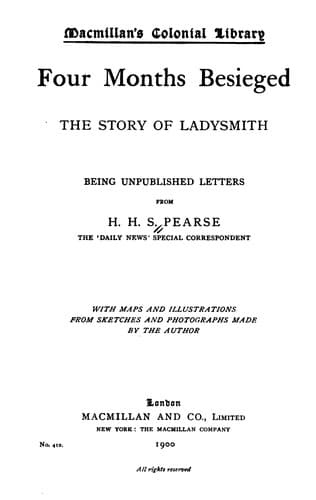
Four Months Besieged: The Story of LadysmithPearse, Henry H. S.
History
Four Months Besieged: The Story of Ladysmith
Pearse, Henry H. S.
Ladysmith (South Africa) -- History -- Siege, 1899-1900
During the fierce fighting at Ladysmith there were times when Sir
George White had grave fears that he would not be longer able to
hold the defences against the enemy. The fortunes of the day, as
the hours lengthened, were reflected in a series of telegrams which
were flashed through by him to Sir Redvers Buller in his camp south
of the Tugela. One of these brief heliograms reported that the
defenders were "hard pressed," and in the afternoon, somewhat
tardily as it seems, General Buller made a demonstration with all
his available force towards the enemy's trenches. The object was to
hold the Boers to their positions on the river, and to prevent the
commandos attacking Ladysmith from being reinforced. As far as
could be ascertained the enemy, however, were in full strength on
the north side of the river, and after ineffectual efforts had been
made to draw their fire the British force returned to camp. Within
four days of this movement, Sir Redvers Buller advanced westward
from Chieveley to make his second attempt to cross the Tugela and
to relieve the town; and it is with the hopes inspired there by the
news and with the tense anxiety with which every indication of
advance or retreat on the distant hills was watched by the
beleaguered garrison, that Mr. Pearse's notes at this time in great
measure deal.
_January 11._--The bombardment has gone on vigorously for several days,
and the Boers are busy on new works, probably with the idea of
"bluffing" us into the belief that they mean to mount new guns, while in
reality they are sending reinforcements southward to intercept General
Buller. The reception yesterday of a message from the Queen thanking the
troops here for their gallant defence aroused much enthusiasm. Lord
Ava's death to-day causes profound regret in every regiment of
Hamilton's Brigade and other camps, where his soldierly qualities and
manly bearing made him a favourite with men and officers alike.
Conspicuous for pluck among the bravest, he met death--where he had
faced it in nearly every action since joining this force--with the
righting line. Of all who fell dead or mortally wounded in the heroic
defence of Bester's Ridge, none will be more sincerely mourned than he.
The civilians of Ladysmith join with the troops in expressions of
respectful sympathy to Lord Dufferin and his family. To-night Lord Ava's
body was buried in the little cemetery, a scene impressive in its simple
solemnity. Brigadier-General Hamilton with his staff; Colonel Rhodes;
Major King, A.D.C., representing the Headquarters Staff, with Sir George
White's personal aide-de-camp; several officers of the Imperial Light
Horse, among whom Lord Ava was wounded; Captain Tilney of Lord Ava's
old regiment; officers of the 5th Lancers, Gordon Highlanders, and Royal
Artillery; several prominent townsmen, and five war correspondents stood
beside the grave.
Public-domain text, read in full here on John Shaqi.
Reviews
Reviews
No reviews yet
Be the first to share your thoughts on this work.
Elsewhere in the archive
Join the Discussion
Join the discussion
Sign in to leave a comment or review.
Sign InorCreate an account