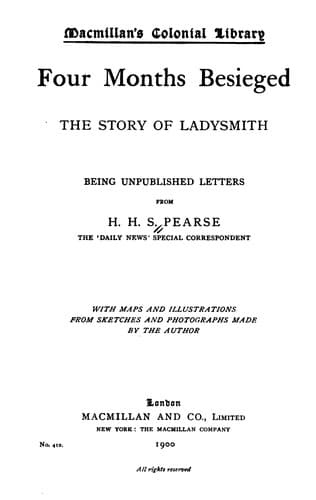
Four Months Besieged: The Story of LadysmithPearse, Henry H. S.
History
Four Months Besieged: The Story of Ladysmith
Pearse, Henry H. S.
Ladysmith (South Africa) -- History -- Siege, 1899-1900
_February 4._--One pathetic incident touched me nearly this morning, as
a forerunner of many that may come soon. I found sitting on a doorstep,
apparently too weak to move, a young fellow of the Imperial Light
Horse--scarcely more than a boy--his stalwart form shrunken by illness.
He was toying with a spray of wild jasmine, as if its perfume brought
back vague memories of home. I learned that he had been wounded at
Elandslaagte and again on Waggon Hill. Then came Intombi and malaria. He
had only been discharged from hospital that morning. His appetite was
not quite equal to the horseflesh test, so he had gone without food. I
took him to my room and gave him such things as a scanty store could
furnish, with the last dram of whisky for a stimulant, and I never felt
more thankful than at that moment for the health and strength that give
an appetite robust enough for any fare.
_February 5._--Just now one could not be wakened by a more welcome sound
than the boom of Buller's guns. It stirred the hazy stillness at dawn
this morning like sweet music. It grew louder and apparently nearer as
the morning advanced, until in imagination one could mark the positions
of individual batteries pounding away opposite Colenso and Skiet's
drift. At last the roar died away in sullen growls, giving us the hope
that a position had been gained.
_February 6._--Again at daybreak we hear the guns of our relieving force
at work in a vigorous cannonade away to the south-west, where Skiet's
Drift lies. They quicken at times to twenty shots a minute, the field
batteries chiming in faintly between the rounds of heavier artillery.
From Observation Hill we can see the enemy's Creusot on a notched ridge
by Doom Kloof replying. Soon after seven o'clock a lyddite shell bursts
there. Its red glare is followed by flame that does not come from
lyddite. Above this darts a black dense cloud speckled with solid
fragments that shoot into the air like bombs. Before we have time to
think that a magazine has been blown up a double report, merging into a
low rumble, reaches our ears. Something has happened to the Boer
battery, and the big gun there remains silent. Buller's artillery
continues firing, more slowly but steadily, at the rate of eight shots a
minute, and rifle fire can be heard rolling nearer all the afternoon.
Boers are reported to be inspanning their teams and collecting cattle on
the plains. The distance is dulled by mists, and the Drakensberg peaks
are only dimly visible, but there are clouds of dust winding that way,
and we know that the Boer waggons are trekking on the off-chance that a
general retirement may be forced upon them. Is this hundredth day of
siege to be the last, or shall we wake to-morrow to hear that the Boer
laagers are back again, and the relieving force once more south of the
Tugela?
Public-domain text, read in full here on John Shaqi.
Reviews
Reviews
No reviews yet
Be the first to share your thoughts on this work.
Elsewhere in the archive
Join the Discussion
Join the discussion
Sign in to leave a comment or review.
Sign InorCreate an account