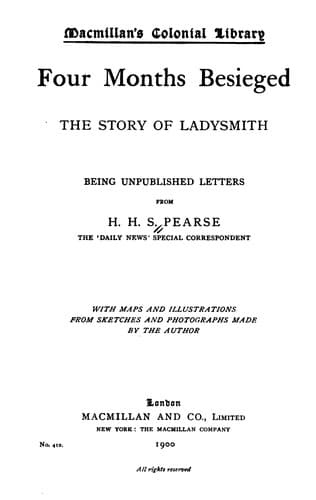
Four Months Besieged: The Story of LadysmithPearse, Henry H. S.
History
Four Months Besieged: The Story of Ladysmith
Pearse, Henry H. S.
Ladysmith (South Africa) -- History -- Siege, 1899-1900
For a whole week daily we have heard the roar of artillery southward and
westward along the Tugela, seen Lyddite shells bursting on Boer
positions, and watched the signs of battle, from which we gather hope
that slowly but surely Buller's army is drawing nearer to us, though by
a different and harder road from the one it tried last. We know that for
a whole week on end those troops have been fighting their way against
entrenched positions that might baulk the bravest soldiers, and still
the roar of battle rolls our way, until between the muffled boom of
heavy guns we can hear faintly the pulse-like throb of rifle volleys.
Amid all this strain, intent upon vital issues, one hardly takes note of
trivialities. Even the daily bombardment seems of little importance, and
nobody cares how many shots "Puffing Billy" fired yesterday. For me the
strain is tightened by news heliographed this morning that another son
has come round from Bulawayo and joined the relieving force as a
lieutenant of Thorneycroft's Mounted Infantry. I don't know whether
pride or anxiety is paramount when I think of these two boys fighting
their way towards me. Both are with Lord Dundonald's Irregular Horse, of
which we have heard much from Kaffirs, who tell us that Thorneycroft's
Rifles and the "Sakkabulu boys," who are now identified as the South
African Light Horse, have been in the front of every fight. It may seem
egotistical to let this personal note stand, but I take the incident to
be an illustration of the spirit that animates English youth at this
moment.
On Saturday (February 17) the artillery fire sounded far off on the
other side of the Tugela. Next morning we could see shells bursting
along the nearer crest of Monte Cristo, and up to eleven o'clock the
fierce cannonade was ceaseless. How the action had ended we could only
judge by Boer movements. From Observation Hill I saw their ambulance
waggons trekking heavy across the plain behind Rifleman's Ridge, then a
bigger waggon, uncovered, drawn by a large span of oxen. There may have
been a long gun in that waggon, its movements were so slow and
cumbersome. Two ambulance waggons passed in the opposite direction,
light and moving at a gallop.
Public-domain text, read in full here on John Shaqi.
Reviews
Reviews
No reviews yet
Be the first to share your thoughts on this work.
Elsewhere in the archive
Join the Discussion
Join the discussion
Sign in to leave a comment or review.
Sign InorCreate an account