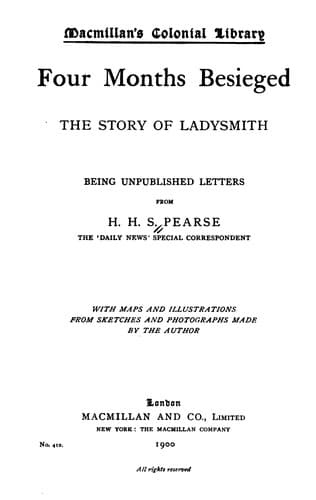
Four Months Besieged: The Story of LadysmithPearse, Henry H. S.
History
Four Months Besieged: The Story of Ladysmith
Pearse, Henry H. S.
Ladysmith (South Africa) -- History -- Siege, 1899-1900
Just before nightfall Sir Redvers Buller's cavalry were reported in
sight. The first token of their coming were loud cheers away on the
plain towards Intombi neutral camp, where some of Colonel Dartnell's
Frontier Police, with Border Mounted Rifles and Natal Carbineers, had
been patrolling since early morning. With joy on their faces, and many
with tears in their eyes, the people rushed towards a drift by which the
Klip River must be crossed. There General Brocklehurst was waiting, and
as a horseman, weather-stained and begrimed by days of bivouacking,
floundered from deep water on to the slippery bank, he was received with
a hearty hand-grip and welcomed to Ladysmith. Then loud cheers went up
for Lord Dundonald, commander of the Second Cavalry Brigade, whose
irregular horsemen have made for themselves a great name as scouts. We
have often heard from Kaffirs about ubiquitous troopers who were
described as wearing sakkabulu feathers in their hats and carrying
assegais. We were all anxious to see these men, and I especially had
often looked out for them, since some one had told me that they were the
South African Light Horse, in which, as I think I have mentioned
elsewhere, a son of mine commands a troop. We had heard of them and
Thorneycroft's Mounted Infantry in the thick of the fight at Spion Kop,
and in many other affairs, but only one came with Lord Dundonald and
the advance guard, in which were Imperial Light Horse, Carbineers, Natal
Police of the Frontier Field Force, and Border Mounted Rifles, numbering
only one hundred and seventy, under Major Mackenzie. They had pushed
forward after the last feeble resistance of the Boer rearguard was
overcome, and Lord Dundonald brought to Sir George White the good news
that Ladysmith's relief was accomplished.
The crowd of soldiers and civilians shouted itself hoarse in cheering
Sir George White when he came with the object of meeting Lord Dundonald.
He could not get through this crowd outside the gaol, where Boer
prisoners were standing on the balcony curious to know what all this
commotion might mean. When a lull gave him an opportunity of speaking,
he said in a voice trembling with emotion, but clear and soldierly for
all that:--
"I thank you men, one and all, from the bottom of my heart, for the help
and support you have given to me, and I shall always acknowledge it to
the end of my life. It grieved me to have to cut your rations, but I
promise you that I will not do it again. I thank God we have kept the
flag flying."
Public-domain text, read in full here on John Shaqi.
Reviews
Reviews
No reviews yet
Be the first to share your thoughts on this work.
Elsewhere in the archive
Join the Discussion
Join the discussion
Sign in to leave a comment or review.
Sign InorCreate an account