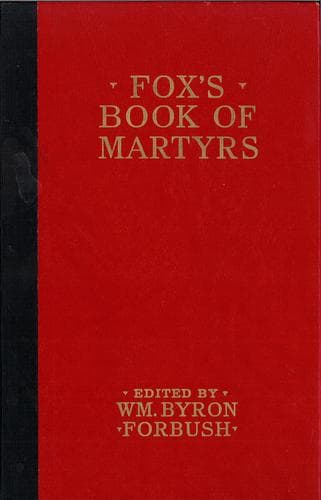
Fox's Book of Martyrs: Or A History of the Lives, Sufferings, and Triumphant; Deaths of the Primitive Protestant MartyrsFoxe, John
HistoryHistory
Fox's Book of Martyrs: Or A History of the Lives, Sufferings, and Triumphant; Deaths of the Primitive Protestant Martyrs
Foxe, John
Church history; Martyrs; Persecution
He now determined to expound, accordingly to the purity of the gospel,
St. Paul's epistle to the Romans, in a regular course of sermons. The
concourse of people that continually attended his preaching was
surprising, but when the priests found the tenor of his doctrines, they
despatched an account of the affair to Rome; when the pope sent a monk,
named Cornelius, to Bononia, to expound the same epistle, according to
the tenets of the church of Rome. The people, however, found such a
disparity between the two preachers, that the audience of Mollius
increased, and Cornelius was forced to preach to empty benches.
Cornelius wrote an account of his bad success to the pope, who
immediately sent an order to apprehend Mollius, who was seized upon
accordingly, and kept in close confinement. The bishop of Bononia sent
him word that he must recant, or be burnt; but he appealed to Rome, and
was removed thither.
At Rome he begged to have a public trial, but that the pope absolutely
denied him, and commanded him to give an account of his opinions in
writing, which he did under the following heads:
Original sin. Free-will. The infallibility of the church of Rome. The
infallibility of the pope. Justification by faith. Purgatory.
Transubstantiation. Mass. Auricular confession. Prayers for the dead.
The host. Prayers for saints. Going on pilgrimages. Extreme unction.
Performing service in an unknown tongue, &c. &c.
All these he confirmed from scripture authority. The pope, upon this
occasion, for political reasons, spared him for the present, but soon
after had him apprehended, and put to death; he being first hanged, and
his body burnt to ashes, A. D. 1553.
The year after, Francis Gamba, a Lombard, of the protestant persuasion,
was apprehended, and condemned to death by the senate of Milan. At the
place of execution, a monk presented a cross to him, to whom he said, My
mind is so full of the real merits and goodness of Christ, that I want
not a piece of senseless stick to put me in mind of him. For this
expression his tongue was bored through, and he was afterwards burnt.
A. D. 1555, Algerius, a student in the university of Padua, and a man of
great learning, having embraced the reformed religion, did all he could
to convert others. For these proceedings he was accused of heresy to the
pope, and being apprehended, was committed to the prison at Venice.
The pope, being informed of Algerius's great learning, and surprising
natural abilities, thought it would be of infinite service to the church
of Rome, if he could induce him to forsake the protestant cause. He,
therefore, sent for him to Rome, and tried, by the most profane
promises, to win him to his purpose. But finding his endeavours
ineffectual, he ordered him to be burnt, which sentence was executed
accordingly.
Public-domain text, read in full here on John Shaqi.
Reviews
Reviews
No reviews yet
Be the first to share your thoughts on this work.
Elsewhere in the archive
Join the Discussion
Join the discussion
Sign in to leave a comment or review.
Sign InorCreate an account