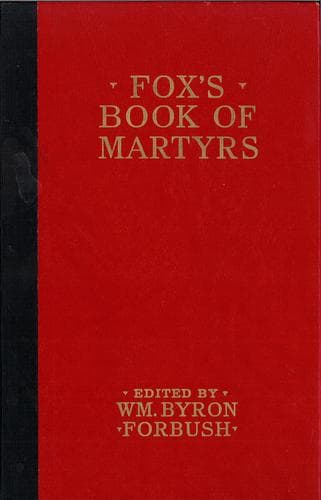
Fox's Book of Martyrs: Or A History of the Lives, Sufferings, and Triumphant; Deaths of the Primitive Protestant MartyrsFoxe, John
HistoryHistory
Fox's Book of Martyrs: Or A History of the Lives, Sufferings, and Triumphant; Deaths of the Primitive Protestant Martyrs
Foxe, John
Church history; Martyrs; Persecution
Being of a contemplative turn of mind, he pursued the track of the
mystical divines, and having acquired great reputation in Spain, and
being desirous of propagating his sublime mode of devotion, he left his
own country, and settled at Rome. Here he soon connected himself with
some of the most distinguished among the literati, who so approved of
his religious maxims, that they concurred in assisting him to propagate
them; and, in a short time, he obtained a great number of followers,
who, from the sublime mode of their religion, were distinguished by the
name of Quietists.
In 1675, Molinos published a book entitled "Il Guida Spirituale," to
which were subjoined recommendatory letters from several great
personages. One of these was by the archbishop of Reggio; a second by
the general of the Franciscans; and a third by father Martin de Esparsa,
a Jesuit, who had been divinity-professor both at Salamanca and Rome.
No sooner was the book published, than it was greatly read, and highly
esteemed, both in Italy and Spain; and this so raised the reputation of
the author, that his acquaintance was coveted by the most respectable
characters. Letters were written to him from numbers of people, so that
a correspondence was settled between him, and those who approved of his
method, in different parts of Europe. Some secular priests, both at Rome
and Naples, declared themselves openly for it, and consulted him, as a
sort of oracle, on many occasions. But those who attached themselves to
him with the greatest sincerity, were some of the fathers of the
Oratory; in particular three of the most eminent, namely, Caloredi,
Ciceri, and Petrucci. Many of the cardinals also courted his
acquaintance, and thought themselves happy in being reckoned among the
number of his friends. The most distinguished of them was the cardinal
d'Estrees, a man of very great learning, who so highly approved of
Molinos' maxims, that he entered into a close connexion with him. They
conversed together daily, and notwithstanding the distrust a Spaniard
has naturally of a Frenchman, yet Molinos, who was sincere in his
principles, opened his mind without reserve to the cardinal; and by this
means a correspondence was settled between Molinos and some
distinguished characters in France.
Whilst Molinos was thus labouring to propagate his religious mode,
father Petrucci wrote several treatises relative to a contemplative
life; but he mixed in them so many rules for the devotions of the Romish
church, as mitigated that censure he might have otherwise incurred. They
were written chiefly for the use of the nuns, and therefore the sense
was expressed in the most easy and familiar style.
Public-domain text, read in full here on John Shaqi.
Reviews
Reviews
No reviews yet
Be the first to share your thoughts on this work.
Elsewhere in the archive
Join the Discussion
Join the discussion
Sign in to leave a comment or review.
Sign InorCreate an account