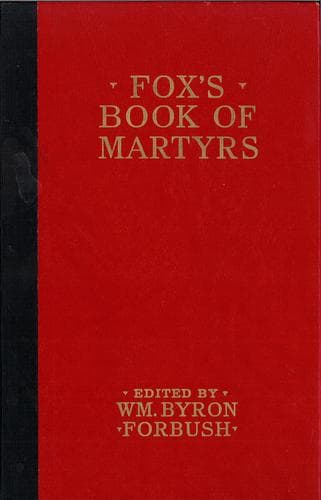
Fox's Book of Martyrs: Or A History of the Lives, Sufferings, and Triumphant; Deaths of the Primitive Protestant MartyrsFoxe, John
HistoryHistory
Fox's Book of Martyrs: Or A History of the Lives, Sufferings, and Triumphant; Deaths of the Primitive Protestant Martyrs
Foxe, John
Church history; Martyrs; Persecution
Zisca now began again to pay attention to the reformation; he forbid all
the prayers for the dead, images, sacerdotal vestments, fasts, and
festivals. Priests were to be preferred according to their merits, and
no one to be persecuted for religious opinions. In every thing Zisca
consulted the liberal minded, and did nothing without general
concurrence. An alarming disagreement now arose at Prague between the
magistrates who were Calixtans, or receivers of the sacraments in both
kinds, and the Taborites, nine of the chiefs of whom were privately
arraigned, and put to death. The populace, enraged, sacrificed the
magistrates, and the affair terminated without any particular
consequence. The Calixtans having sunk into contempt, Zisca was
solicited to assume the crown of Bohemia; but this he nobly refused, and
prepared for the next campaign, in which Sigismond resolved to make his
last effort. While the marquis of Misnia penetrated into Upper Saxony,
the emperor proposed to enter Moravia, on the side of Hungary. Before
the marquis had taken the field, Zisca sat down before the strong town
of Ausig, situate on the Elbe. The marquis flew to its relief with a
superior army, and, after an obstinate engagement, was totally defeated
and Ausig capitulated. Zisca then went to the assistance of Procop, a
young general whom he had appointed to keep Sigismond in check, and whom
he compelled to abandon the siege of Pernitz, after laying eight weeks
before it.
Zisca, willing to give his troops some respite from fatigue, now entered
Prague, hoping his presence would quell any uneasiness that might remain
after the late disturbance: but he was suddenly attacked by the people;
and he and his troop having beaten off the citizens effected a retreat
to his army, whom he acquainted with the treacherous conduct of the
Calixtans. Every effort of address was necessary to appease their
vengeful animosity, and at night, in a private interview between
Roquesan, an ecclesiastic of great eminence in Prague, and Zisca, the
latter became reconciled, and the intended hostilities were done away.
Mutually tired of the war, Sigismond sent to Zisca, requesting him to
sheath his sword, and name his conditions. A place of congress being
appointed, Zisca, with his chief officers, set out to meet the emperor.
Compelled to pass through a part of the country where the plague raged,
he was seized with it at the castle of Briscaw and departed this life,
October 6, 1424. Like Moses, he died in view of the completion of his
labours, and was buried in the great church of Czaslow, in Bohemia,
where a monument is erected to his memory, with this inscription on
it--"Here lies John Zisca, who, having defended his country against the
encroachments of papal tyranny, rests in this hallowed place in despite
of the pope."
After the death of Zisca, Procop was defeated, and fell with the
liberties of his country.
Public-domain text, read in full here on John Shaqi.
Reviews
Reviews
No reviews yet
Be the first to share your thoughts on this work.
Elsewhere in the archive
Join the Discussion
Join the discussion
Sign in to leave a comment or review.
Sign InorCreate an account