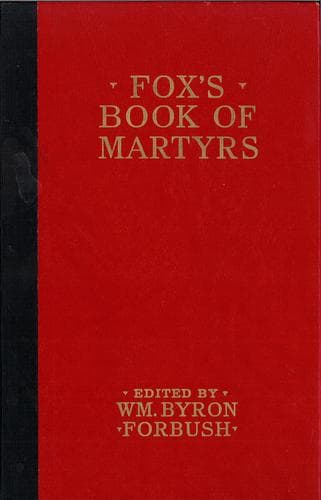
Fox's Book of Martyrs: Or A History of the Lives, Sufferings, and Triumphant; Deaths of the Primitive Protestant MartyrsFoxe, John
HistoryHistory
Fox's Book of Martyrs: Or A History of the Lives, Sufferings, and Triumphant; Deaths of the Primitive Protestant Martyrs
Foxe, John
Church history; Martyrs; Persecution
In A. D. 868, these barbarians penetrated into the centre of England,
and took up their quarters at Nottingham; but the English, under their
king Ethelfrid, drove them from their posts, and obliged them to retire
to Northumberland.
In 870, another body of these barbarians landed at Norfolk, and engaged
in battle with the English at Hertford. Victory declared in favour of
the pagans, who took Edmund, king of the East Angles, prisoner, and
after treating him with a thousand indignities, transfixed his body with
arrows, and then beheaded him.
In Fifeshire, in Scotland, they burnt many of the churches, and among
the rest that belonging to the Culdees, at St. Andrews. The piety of
these men made them objects of abhorrence to the Danes, who, wherever
they went singled out the christian priests for destruction, of whom no
less than 200 were massacred in Scotland.
It was much the same in that part of Ireland now called Leinster, there
the Danes murdered and burnt the priests alive in their own churches;
they carried destruction along with them wherever they went, sparing
neither age nor sex, but the clergy were the most obnoxious to them,
because they ridiculed their idolatry, and persuaded their people to
have nothing to do with them.
In the reign of Edward III. the church of England was extremely
corrupted with errors and superstition; and the light of the gospel of
Christ was greatly eclipsed and darkened with human inventions,
burthensome ceremonies, and gross idolatry.
The followers of Wickliffe, then called Lollards, were become extremely
numerous, and the clergy were so vexed to see them increase whatever
power or influence they might have to molest them in an underhand
manner, they had no authority by law to put them to death. However, the
clergy embraced the favourable opportunity, and prevailed upon the king
to suffer a bill to be brought into parliament, by which all Lollards
who remained obstinate, should be delivered over to the secular power,
and burnt as heretics. This act was the first in Britain for the burning
of people for their religious sentiments; it passed in the year 1401,
and was soon after put into execution.
The first person who suffered in consequence of this cruel act was
William Santree, or Sawtree, a priest, who was burnt to death in
Smithfield.
Soon after this, lord Cobham, in consequence of his attachment to the
doctrines of Wickliffe, was accused of heresy, and being condemned to be
hanged and burnt, was accordingly executed in Loncoln's-Inn Fields, A.
D. 1419.
The next man who suffered under this bloody statute was Thomas Bradley,
a tailor, and a layman; and a letter having been tendered him, which he
refused, he was declared an obstinate heretic, and tied to the stake in
Smithfield; where he was burnt alive, rejoicing in the Lord his God.
Public-domain text, read in full here on John Shaqi.
Reviews
Reviews
No reviews yet
Be the first to share your thoughts on this work.
Elsewhere in the archive
Join the Discussion
Join the discussion
Sign in to leave a comment or review.
Sign InorCreate an account