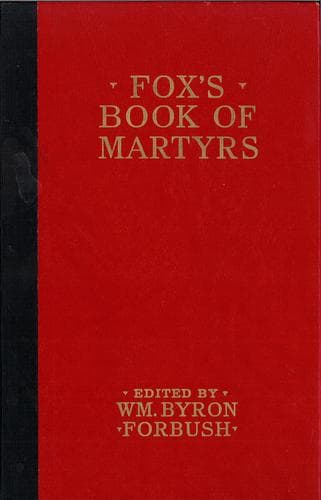
Fox's Book of Martyrs: Or A History of the Lives, Sufferings, and Triumphant; Deaths of the Primitive Protestant MartyrsFoxe, John
HistoryHistory
Fox's Book of Martyrs: Or A History of the Lives, Sufferings, and Triumphant; Deaths of the Primitive Protestant Martyrs
Foxe, John
Church history; Martyrs; Persecution
At the latter end of this year, Mr. Thomas Bennet, a school-master, was
apprehended at Exeter, and being brought before the bishop, refused to
recant his opinions, for which he was delivered over to the secular
power, and burned alive near that city.
In the year 1538, one Collins, a madman, suffered death with his dog in
Smithfield. The circumstances were as follow: Collins happened to be in
church when the priest elevated the host; and Collins, in derision of
the sacrifice of the Mass, lifted up his dog above his head. For this
crime Collins, who ought to have been sent to a madhouse, or whipped at
the cart's tail, was brought before the bishop of London; and although
he was really mad, yet such was the force of popish power, such the
corruption in church and state, that the poor madman, and his dog, were
both carried to the stake in Smithfield, where they were burned to
ashes, amidst a vast crowd of spectators.
There were some other persons who suffered the same year, of whom we
shall take notice in the order they lie before us.
One Cowbridge suffered at Oxford; and although he was reputed to be a
madman, yet he showed great signs of piety when he was fastened to the
stake, and after the flames were kindled around him.
About the same time one Purderve was put to death, for saying privately
to a priest, after he had drunk the wine, "He blessed the hungry people
with the empty chalice."
At the same time was condemned William Letton, a monk of great age, in
the county of Suffolk, who was burned at Norwich for speaking against an
idol that was carried in procession; and for asserting, that the
sacrament should be administered in both kinds.
Some time before the burning of these men, Nicholas Peke was executed at
Norwich; and when the fire was lighted, he was so scorched that he was
as black as pitch. Dr. Reading standing before him, with Dr. Hearne and
Dr. Spragwell, having a long white wand in his hand, struck him upon the
right shoulder, and said, "Peke, recant, and believe in the Sacrament."
To this he answered, "I despise thee and it also;" and with great
violence he spit blood, occasioned by the anguish of his sufferings. Dr.
Reading granted forty days indulgence for the sufferer, in order that he
might recant his opinions. But he persisted in his adherence to the
truth, without paying any regard to the malice of his enemies; and he
was burned alive, rejoicing that Christ had counted him worthy to
suffer for his name's sake.
On July 28, 1540, or 1541, (for the chronology differs) Thomas Cromwell,
earl of Essex, was brought to a scaffold on Tower-hill, where he was
executed with some striking instances of cruelty. He made a short speech
to the people, and then meekly resigned himself to the axe.
Public-domain text, read in full here on John Shaqi.
Reviews
Reviews
No reviews yet
Be the first to share your thoughts on this work.
Elsewhere in the archive
Join the Discussion
Join the discussion
Sign in to leave a comment or review.
Sign InorCreate an account