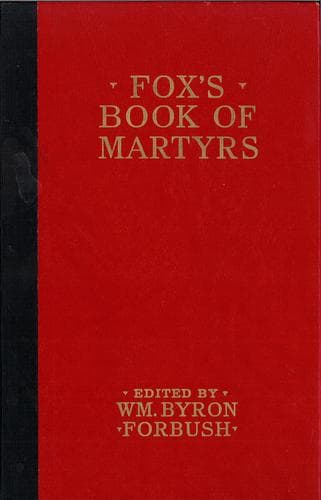
Fox's Book of Martyrs: Or A History of the Lives, Sufferings, and Triumphant; Deaths of the Primitive Protestant MartyrsFoxe, John
HistoryHistory
Fox's Book of Martyrs: Or A History of the Lives, Sufferings, and Triumphant; Deaths of the Primitive Protestant Martyrs
Foxe, John
Church history; Martyrs; Persecution
The martyrdoms of the two before-mentioned persons, were soon followed
by that of Mr. Thomas Forret, who, for a considerable time, had been
dean of the Romish church; Killor and Beverage, two blacksmiths; Duncan
Simson, a priest; and Robert Forrester, a gentleman. They were all burnt
together, on the Castle-hill at Edinburgh, the last day of February,
1538.
The year following the martyrdoms of the before-mentioned persons, viz.
1539, two others were apprehended on a suspicion of heresy; namely,
Jerom Russel, and Alexander Kennedy, a youth about eighteen years of
age.
These two persons, after being some time confined in prison, were
brought before the archbishop for examination. In the course of which,
Russel, being a very sensible man, reasoned learnedly against his
accusers; while they in return made use of very opprobrious language.
The examination being over, and both of them deemed heretics, the
archbishop pronounced the dreadful sentence of death, and they were
immediately delivered over to the secular power in order for execution.
The next day they were led to the place appointed for them to suffer; in
their way to which, Russel, seeing his fellow-sufferer have the
appearance of timidity in his countenance, thus addressed him: "Brother,
fear not; greater is he that is in us, than he that is in the world. The
pain that we are to suffer is short, and shall be light; but our joy and
consolation shall never have an end. Let us, therefore, strive to enter
into our Master and Saviour's joy, by the same straight way which he
hath taken before us. Death cannot hurt us, for it is already destroyed
by Him, for whose sake we are now going to suffer."
When they arrived at the fatal spot, they both kneeled down and prayed
for some time; after which being fastened to the stake, and the fagots
lighted, they cheerfully resigned their souls into the hands of Him who
gave them, in full hopes of an everlasting reward in the heavenly
mansions.
In 1543, the archbishop of St. Andrews made a visitation into various
parts of his diocese, where several persons were informed against at
Perth for heresy. Among these the following were condemned to die, viz.
William Anderson, Robert Lamb, James Finlayson, James Hunter, James
Raveleson, and Helen Stark.
The accusations laid against these respective persons were as follow:
The four first were accused of having hung up the image of St. Francis,
nailing ram's horns on his head, and fastening a cow's tail to his rump;
but the principal matter on which they were condemned was, having
regaled themselves with a goose on fast day.
James Raveleson was accused of having ornamented his house with the
three crowned diadem of Peter, carved in wood, which the archbishop
conceived to be done in mockery to his cardinal's cap.
Helen Stark was accused of not having accustomed herself to pray to the
Virgin Mary, more especially during the time she was in child bed.
Public-domain text, read in full here on John Shaqi.
Reviews
Reviews
No reviews yet
Be the first to share your thoughts on this work.
Elsewhere in the archive
Join the Discussion
Join the discussion
Sign in to leave a comment or review.
Sign InorCreate an account