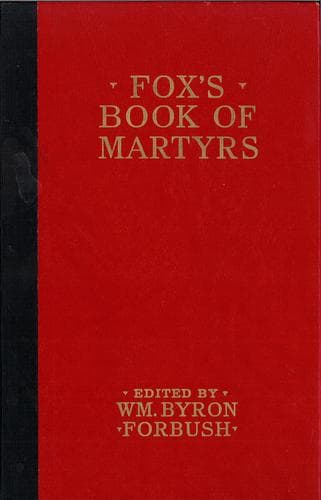
Fox's Book of Martyrs: Or A History of the Lives, Sufferings, and Triumphant; Deaths of the Primitive Protestant MartyrsFoxe, John
HistoryHistory
Fox's Book of Martyrs: Or A History of the Lives, Sufferings, and Triumphant; Deaths of the Primitive Protestant Martyrs
Foxe, John
Church history; Martyrs; Persecution
His principal accusers and persecutors, on a charge of praemunire in the
reign of Edward VI. were George Constantine Walter, his servant; Thomas
Young, chanter of the cathedral, afterward bishop of Bangor, &c. Dr.
Farrar ably replied to the copies of information laid against him,
consisting of fifty-six articles. The whole process of this trial was
long and tedious. Delay succeeded delay, and after that Dr. Farrar had
been long unjustly detained in custody under sureties, in the reign of
king Edward, because he had been promoted by the duke of Somerset,
whence after his fall he found fewer friends to support him against such
as wanted his bishopric by the coming in of queen Mary, he was accused
and examined not for any matter of praemunire, but for his faith and
doctrine; for which he was called before the Bishop of Winchester with
bishop Hooper, Mr. Rogers, Mr. Bradford, Mr. Saunders and others, Feb.
4, 1555; on which day he would also with them have been condemned, but
his condemnation was deferred, and he sent to prison again, where he
continued till Feb. 14, and then was sent into Wales to receive
sentence. He was six times brought up before Henry Morgan, bishop of St.
David's, who demanded if he would abjure; from which he zealously
dissented, and appealed to cardinal Pole; notwithstanding which, the
bishop, proceeding in his rage, pronounced him a heretic excommunicate,
and surrendered him to the secular power.
Dr. Farrar, being condemned and degraded, was not long after brought to
the place of execution in the town of Carmathen, in the market-place of
which, on the south side of the market-cross, March 30, 1555, being
Saturday next before Passion-Sunday, he most constantly sustained the
torments of the fire.
Concerning his constancy, it is said that one Richard Jones, a knight's
son, coming to Dr. Farrar a little before his death, seemed to lament
the painfulness of the death he had to suffer; to whom the bishop
answered, That if he saw him once stir in the pains of his burning, he
ought then give no credit to his doctrine; and as he said, so did he
maintain his promise, patiently standing without emotion, till one
Richard Gravell with a staff struck him down.
_Rawlins White._
Rawlins White was by his calling and occupation a fisherman, living and
continuing in the said trade for the space of twenty years at least, in
the town of Cardiff, where he bore a very good name amongst his
neighbours.
Though the good man was altogether unlearned, and withal very simple,
yet it pleased God to remove him from error and idolatry to a knowledge
of the truth, through the blessed reformation in Edward's reign. He had
his son taught to read English, and after the little boy could read
pretty well, his father every night after supper, summer and winter,
made the boy read a portion of the holy scriptures, and now and then a
part of some other good book.
Public-domain text, read in full here on John Shaqi.
Reviews
Reviews
No reviews yet
Be the first to share your thoughts on this work.
Elsewhere in the archive
Join the Discussion
Join the discussion
Sign in to leave a comment or review.
Sign InorCreate an account