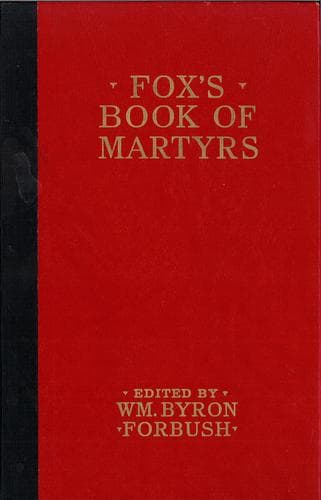
Fox's Book of Martyrs: Or A History of the Lives, Sufferings, and Triumphant; Deaths of the Primitive Protestant MartyrsFoxe, John
HistoryHistory
Fox's Book of Martyrs: Or A History of the Lives, Sufferings, and Triumphant; Deaths of the Primitive Protestant Martyrs
Foxe, John
Church history; Martyrs; Persecution
William Flower, otherwise Branch, was born at Snow-hill, in the county
of Cambridge, where he went to school some years, and then came to the
abbey of Ely. After he had remained a while he became a professed monk,
was made a priest in the same house, and there celebrated and sang mass.
After that, by reason of a visitation, and certain injunctions by the
authority of Henry VIII he took upon him the habit of a secular priest,
and returned to Snow-hill, where he was born, and taught children about
half a year.
He then went to Ludgate, in Suffolk, and served as a secular priest
about a quarter of a year; from thence to Stoniland; at length to
Tewksbury, where he married a wife, with whom he ever after faithfully
and honestly continued: after marriage he resided at Tewksbury about two
years, and from thence went to Brosley, where he practised physic and
surgery; but departing from those parts, he came to London, and finally
settled at Lambeth, where he and his wife dwelt together: however, he
was generally abroad, excepting once or twice in a month, to visit and
see his wife. Being at home upon Easter Sunday morning, he came over the
water from Lambeth into St. Margaret's church at Westminster; when
seeing a priest, named John Celtham, administering and giving the
sacrament of the altar to the people, and being greatly offended in his
conscience with the priest for the same, he struck and wounded him upon
the head, and also upon the arm and hand, with his wood knife, the
priest having at the same time in his hand a chalice with the
consecrated host therein, which became sprinkled with blood.
Mr. Flower, for this injudicious zeal, was heavily ironed, and put into
the gatehouse at Westminster; and afterward summoned before bishop
Bonner and his ordinary, where the bishop, after he had sworn him upon a
book, ministered articles and interrogations to him.
After examination, the bishop began to exhort him again to return to the
unity of his mother the catholic church, with many fair promises. These
Mr. Flower steadfastly rejecting, the bishop ordered him to appear in
the same place in the afternoon, and in the mean time to consider well
his former answer; but he, neither apologizing for having struck the
priest, nor swerving from his faith, the bishop assigned him the next
day, April 20th, to receive sentence, if he would not recant. The next
morning, the bishop accordingly proceeded to the sentence, condemning
and excommunicating him for a heretic, and after pronouncing him to be
degraded, committed him to the secular power.
April 24, St. Mark's eve, he was brought to the place of martyrdom, in
St. Margaret's churchyard, Westminster, where the fact was committed:
and there coming to the stake, he prayed to Almighty God, made a
confession of his faith, and forgave all the world.
Public-domain text, read in full here on John Shaqi.
Reviews
Reviews
No reviews yet
Be the first to share your thoughts on this work.
Elsewhere in the archive
Join the Discussion
Join the discussion
Sign in to leave a comment or review.
Sign InorCreate an account