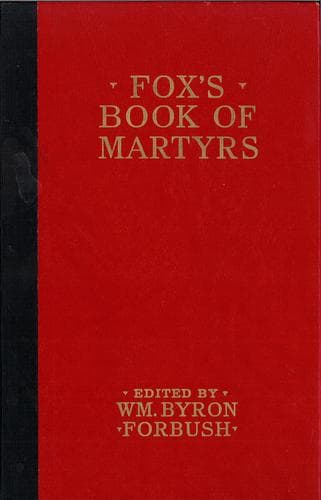
Fox's Book of Martyrs: Or A History of the Lives, Sufferings, and Triumphant; Deaths of the Primitive Protestant MartyrsFoxe, John
HistoryHistory
Fox's Book of Martyrs: Or A History of the Lives, Sufferings, and Triumphant; Deaths of the Primitive Protestant Martyrs
Foxe, John
Church history; Martyrs; Persecution
Mr. Bradford, being come to the place, fell flat on the ground, secretly
making his prayers to Almighty God. Then, rising again, and putting off
his clothes unto the shirt, he went to the stake, and there suffered
with a young man of twenty years of age, whose name was John Leaf, an
apprentice to Mr. Humphry Gaudy, tallow-chandler, of Christ-church,
London. Upon Friday before Palm Sunday, he was committed to the Compter
in Bread-street, and afterward examined and condemned by the bloody
bishop.
It is reported of him, that, when the bill of his confession was read
unto him, instead of pen, he took a pin, and pricking his hand,
sprinkled the blood upon the said bill, desiring the reader thereof to
show the bishop that he had sealed the same bill with his blood already.
They both ended this mortal life, July 12th, 1555, like two lambs,
without any alteration of their countenances, hoping to obtain that
prize they had long run for; to which may Almighty God conduct us all,
through the merits of Christ our Saviour! We shall conclude this article
with mentioning, that Mr. Sheriff Woodroffe, it is said, within half a
year after, was struck on the right side with a palsy and for the space
of eight years after, (till his dying day) he was unable to turn
himself in his bed; thus he became at last a fearful object to behold.
The day after Mr. Bradford and John Leaf suffered in Smithfield, William
Minge, priest, died in prison at Maidstone. With as great constancy and
boldness he yielded up his life in prison, as if it had pleased God to
have called him to suffer by fire, as other godly men had done before at
the stake, and as he himself was ready to do, had it pleased God to have
called him to this trial.
_Rev. John Bland, Rev. John Frankesh, Nicholas Shetterden, and Humphrey
Middleton._
These Christian persons were all burnt at Canterbury for the same cause.
Frankesh and Bland were ministers and preachers of the word of God, the
one being parson of Adesham, and the other vicar of Rolvindon. Mr. Bland
was cited to answer for his opposition to antichristianism, and
underwent several examinations before Dr. Harpsfield, archdeacon of
Canterbury, and finally on the 25th of June, 1555, again withstanding
the power of the pope, he was condemned, and delivered to the secular
arm. On the same day were condemned, John Frankesh, Nicholas Shetterden,
Humphrey Middleton, Thacker, and Cocker, of whom Thacker only recanted.
Being delivered to the secular power, Mr. Bland, with the three former,
were all burnt together at Canterbury, July 12, 1555, at two several
stakes, but in one fire, when they, in the sight of God and his angels,
and before men, like true soldiers of Jesus Christ, gave a constant
testimony to the truth of his holy gospel.
_Nicholas Hall and Christopher Waid._
Public-domain text, read in full here on John Shaqi.
Reviews
Reviews
No reviews yet
Be the first to share your thoughts on this work.
Elsewhere in the archive
Join the Discussion
Join the discussion
Sign in to leave a comment or review.
Sign InorCreate an account