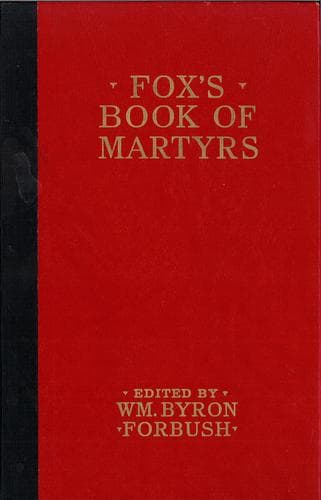
Fox's Book of Martyrs: Or A History of the Lives, Sufferings, and Triumphant; Deaths of the Primitive Protestant MartyrsFoxe, John
HistoryHistory
Fox's Book of Martyrs: Or A History of the Lives, Sufferings, and Triumphant; Deaths of the Primitive Protestant Martyrs
Foxe, John
Church history; Martyrs; Persecution
The beginning of the year 1557, was remarkable for the visit of Cardinal
Pole to the University of Cambridge, which seemed to stand in need of
much cleansing from heretical preachers and reformed doctrines. One
object was also to play the popish farce of trying Martin Bucer and
Paulus Phagius, who had been buried about three or four years; for which
purpose the churches of St. Mary and St. Michael, where they lay, were
interdicted as vile and unholy places, unfit to worship God in, until
they were perfumed and washed with the Pope's holy water, &c. &c. The
trumpery act of citing these dead reformers to appear, not having had
the least effect upon them, on January 26, sentence of condemnation was
passed, part of which ran in this manner, and may serve as a specimen of
proceedings of this nature:--"We therefore pronounce the said Martin
Bucer and Paulus Phagius excommunicated and anathematized, as well by
the common law, as by letters of process; and that their memory be
condemned, we also condemn their bodies and bones (which in that wicked
time of schism, and other heresies flourishing in this kingdom, were
rashly buried in holy ground) to be dug up, and cast far from the bodies
and bones of the faithful, according to the holy canons; and we command
that they and their writings, if any be there found, be publicly burnt;
and we interdict all persons whatsoever of this university, town, or
places adjacent, who shall read or conceal their heretical book, as
well by the common law, as by our letters of process!"
After the sentence thus read, the bishop commanded their bodies to be
dug out of their graves, and being degraded from holy orders, delivered
them into the hands of the secular power; for it was not lawful for such
innocent persons as they were, abhorring all bloodshed, and detesting
all desire of murder, to put any man to death.
February 6, the bodies, enclosed as they were in chests, were carried
into the midst of the market place at Cambridge, accompanied by a vast
concourse of people. A great post was set fast in the ground, to which
the chests were affixed with a large iron chain, and bound round their
centres, in the same manner as if the dead bodies had been alive. When
the fire began to ascend, and caught the coffins, a number of condemned
books were also launched into the flames, and burnt. Justice, however,
was done to the memories of these pious and learned men in queen
Elizabeth's reign, when Mr. Ackworth, orator of the university, and Mr.
J. Pilkington, pronounced orations in honour of their memory, and in
reprobation of their catholic persecutors.
Public-domain text, read in full here on John Shaqi.
Reviews
Reviews
No reviews yet
Be the first to share your thoughts on this work.
Elsewhere in the archive
Join the Discussion
Join the discussion
Sign in to leave a comment or review.
Sign InorCreate an account