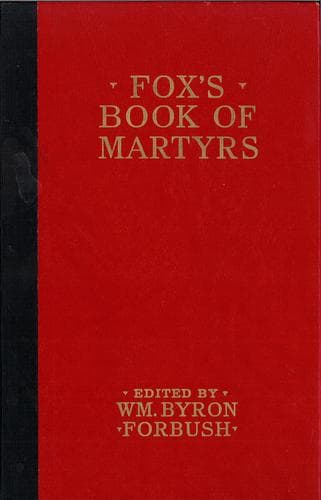
Fox's Book of Martyrs: Or A History of the Lives, Sufferings, and Triumphant; Deaths of the Primitive Protestant MartyrsFoxe, John
HistoryHistory
Fox's Book of Martyrs: Or A History of the Lives, Sufferings, and Triumphant; Deaths of the Primitive Protestant Martyrs
Foxe, John
Church history; Martyrs; Persecution
In November, Thomas Spurdance, one of queen Mary's servants, was brought
before the chancellor of Norwich, who, among his interrogations, was
severely recriminated upon by the prisoner. This good man was taken by
two of his fellow-servants, dwelling at Codman, in Suffolk. He was sent
to Bury where he remained some time in prison, and in November, 1557,
braved the fiery indignation of the enemies of Christ with Christian
fortitude and resignation.
J. Hallingdale, W. Sparrow, and R Gibson, suffered in Smithfield
November 18th, 1557.
_Rev. John Rough._
This pious martyr was a Scotchman: at the age of 17, he entered himself
as one of the order of Black Friars, at Stirling, in Scotland. He had
been kept out of an inheritance by his friends, and he took this step in
revenge for their conduct to him. After being there sixteen years, Lord
Hamilton, Earl of Arran, taking a liking to him, the archbishop of St.
Andrew's induced the provincial of the house to dispense with his habit
and order; and he thus became the Earl's chaplain. He remained in this
spiritual employment a year, and in that time God wrought in him a
saving knowledge of the truth; for which reason the Earl sent him to
preach in the freedom of Ayr, where he remained four years; but finding
danger there from the religious complexion of the times, and learning
that there was much gospel freedom in England, he travelled up to the
duke of Somerset, then Lord Protector of England, who gave him a yearly
salary of twenty pounds, and authorized him, to preach at Carlisle,
Berwick, and Newcastle, where he married. He was afterward removed to a
benefice at Hull, in which he remained till the death of Edward VI.
In consequence of the tide of persecution then setting in, he fled with
his wife to Friesland, and at Nordon they followed the occupation of
knitting hose, caps, &c. for subsistence. Impeded in his business by the
want of yarn, he came over to England to procure a quantity, and on Nov.
10th, arrived in London, where he soon heard of a secret society of the
faithful, to whom he joined himself, and was in a short time elected
their minister, in which occupation he strengthened them in every good
resolution. Dec. 12th, through the information of one Taylor, a member
of the society, Mr. Rough, with Cuthbert Symson and others, was taken up
in the Saracen's Head, Islington, where, under the pretext of coming to
see a play, their religious exercises were holden. The queen's
vice-chamberlain conducted Rough and Symson before the council, in whose
presence they were charged with meeting to celebrate the communion. The
council wrote to Bonner and he lost no time in this affair of blood. In
three days he had him up, and on the next (the 20th) resolved to condemn
him. The charges laid against him were, that he, being a priest, was
married, and that he had rejected the service in the Latin tongue. Rough
wanted not arguments to reply to these flimsy tenets. In short, he was
degraded and condemned.
Public-domain text, read in full here on John Shaqi.
Reviews
Reviews
No reviews yet
Be the first to share your thoughts on this work.
Elsewhere in the archive
Join the Discussion
Join the discussion
Sign in to leave a comment or review.
Sign InorCreate an account