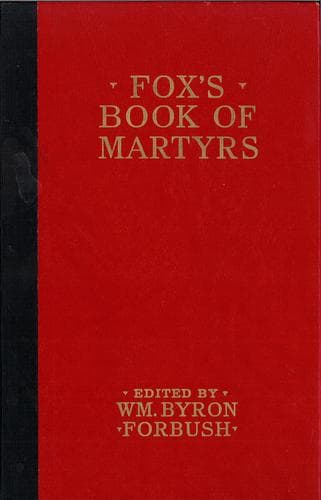
Fox's Book of Martyrs: Or A History of the Lives, Sufferings, and Triumphant; Deaths of the Primitive Protestant MartyrsFoxe, John
HistoryHistory
Fox's Book of Martyrs: Or A History of the Lives, Sufferings, and Triumphant; Deaths of the Primitive Protestant Martyrs
Foxe, John
Church history; Martyrs; Persecution
The martyrdom of Almericus and his pupils did not, however, prevent many
from acknowledging the justness of his notions, and seeing the purity of
the reformed religion, so that the truth of Christ continually
increased, and in time not only spread itself over many parts of France,
but diffused the light of the gospel over various other countries.
In the year 1524, at a town in France, called Melden, one John Clark set
up a bill on the church door, wherein he called the pope Anti-christ.
For this offence he was repeatedly whipped, and then branded on the
forehead. Going afterward to Mentz, in Lorraine, he demolished some
images, for which he had his right hand and nose cut off, and his arms
and breasts torn with pincers. He sustained these cruelties with amazing
fortitude, and was even sufficiently cool to sing the 115th psalm, which
expressly forbids idolatry; after which he was thrown into the fire, and
burnt to ashes.
Many persons of the reformed persuasion were, about this time, beaten,
racked, scourged, and burnt to death, in several parts of France but
more particularly at Paris, Malda, and Limosin.
A native of Malda was burnt by a slow fire, for saying that mass was a
plain denial of the death and passion of Christ. At Limosin, John de
Cadurco, a clergyman of the reformed religion, was apprehended,
degraded, and ordered to be burnt.
Francis Bribard, secretary to cardinal de Pellay, for speaking in favour
of the reformed, had his tongue cut out, and was then burnt, A. D. 1545.
James Cobard, a schoolmaster in the city of St. Michael, was burnt, A.
D. 1545, for saying "That mass was useless and absurd;" and about the
same time, fourteen men were burnt at Malda, their wives being compelled
to stand by and behold the execution.
A. D. 1546, Peter Chapot brought a number of bibles in the French tongue
to France, and publicly sold them there; for which he was brought to
trial, sentenced, and executed a few days afterward. Soon after, a
cripple of Meaux, a schoolmaster of Fera, named Stephen Polliot, and a
man named John English, were burnt for the faith.
Monsieur Blondel, a rich jeweller, was, A. D. 1548, apprehended at
Lyons, and sent to Paris; where he was burnt for the faith, by order of
the court, A. D. 1549. Herbert, a youth of nineteen years of age, was
committed to the flames at Dijon; as was Florent Venote, in the same
year.
In the year 1554, two men of the reformed religion, with the son and
daughter of one of them, were apprehended and committed to the castle of
Niverne. On examination, they confessed their faith, and were ordered
for execution; being smeared with grease, brimstone, and gunpowder, they
cried, "Salt on, salt on this sinful and rotten flesh!" Their tongues
were then cut out, and they were afterward committed to the flames,
which soon consumed them, by means of the combustible matter with which
they were besmeared.
_The Bartholomew Massacre at Paris, &c._
Public-domain text, read in full here on John Shaqi.
Reviews
Reviews
No reviews yet
Be the first to share your thoughts on this work.
Elsewhere in the archive
Join the Discussion
Join the discussion
Sign in to leave a comment or review.
Sign InorCreate an account