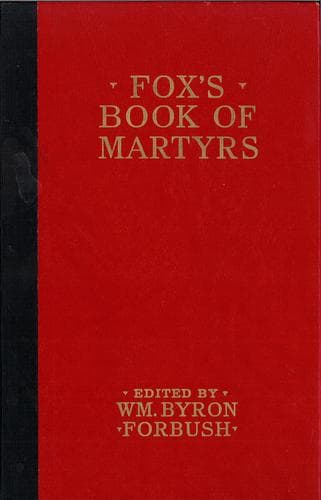
Fox's Book of Martyrs: Or A History of the Lives, Sufferings, and Triumphant; Deaths of the Primitive Protestant MartyrsFoxe, John
HistoryHistory
Fox's Book of Martyrs: Or A History of the Lives, Sufferings, and Triumphant; Deaths of the Primitive Protestant Martyrs
Foxe, John
Church history; Martyrs; Persecution
of the Turks that preside at the oars, who strip them quite naked, and
stretching them upon a great gun, they are held so that they cannot
stir; during which there reigns an awful silence throughout the galley.
The Turk who is appointed the executioner, and who thinks the sacrifice
acceptable to his prophet Mahomet, most cruelly beats the wretched
victim with a rough cudgel, or knotty rope's end, till the skin is
flayed off his bones, and he is near the point of expiring; then they
apply a most tormenting mixture of vinegar and salt, and consign him to
that most intolerable hospital where thousands under their cruelties
have expired.
_Martyrdom of John Calas._
We pass over many other individual martyrdoms to insert that of John
Calas, which took place so lately as 1761, and is an indubitable proof
of the bigotry of popery, and shows that neither experience nor
improvement can root out the inveterate prejudices of the Roman
catholics, or render them less cruel or inexorable to protestants.
John Calas was a merchant of the city of Thoulouse, where he had been
settled, and lived in good repute, and had married an English woman of
French extraction. Calas and his wife were protestants, and had five
sons, whom they educated in the same religion; but Lewis, one of the
sons, became a Roman catholic, having been converted by a maid-servant,
who had lived in the family about thirty years. The father, however, did
not express any resentment or ill-will upon the occasion, but kept the
maid in the family and settled an annuity upon the son. In October,
1761, the family consisted of John Calas and his wife, one woman
servant, Mark Antony Calas, the eldest son, and Peter Calas, the second
son. Mark Antony was bred to the law, but could not be admitted to
practise, on account of his being a protestant; hence he grew
melancholy, read all the books he could procure relative to suicide, and
seemed determined to destroy himself. To this may be added, that he led
a dissipated life, was greatly addicted to gaming, and did all which
could constitute the character of a libertine; on which account his
father frequently reprehended him and sometimes in terms of severity,
which considerably added to the doom that seemed to oppress him.
On the 13th of October, 1761, Mr. Gober la Vaisse, a young gentleman
about 19 years of age, the son of La Vaisse, a celebrated advocate of
Thoulouse, about five o'clock in the evening, was met by John Calas, the
father, and the eldest son Mark Antony, who was his friend. Calas, the
father, invited him to supper, and the family and their guest sat down
in a room up one pair of stairs; the whole company, consisting of Calas
the father and his wife, Antony and Peter Calas, the sons, and La Vaisse
the guest, no other person being in the house, except the maid-servant
who has been already mentioned.
Public-domain text, read in full here on John Shaqi.
Reviews
Reviews
No reviews yet
Be the first to share your thoughts on this work.
Elsewhere in the archive
Join the Discussion
Join the discussion
Sign in to leave a comment or review.
Sign InorCreate an account