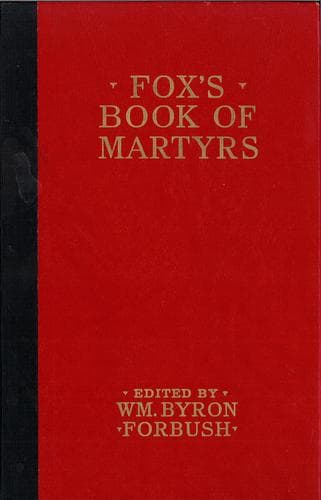
Fox's Book of Martyrs: Or A History of the Lives, Sufferings, and Triumphant; Deaths of the Primitive Protestant MartyrsFoxe, John
HistoryHistory
Fox's Book of Martyrs: Or A History of the Lives, Sufferings, and Triumphant; Deaths of the Primitive Protestant Martyrs
Foxe, John
Church history; Martyrs; Persecution
The poor father, overwhelmed with grief for the loss of his child, was
advised by his friends to send for the officers of justice to prevent
his being torn to pieces by the catholic multitude, who supposed he had
murdered his son. This was accordingly done, and David, the chief
magistrate, or capitoul, took the father, Peter the son, the mother, La
Vaisse, and the maid, all into custody, and set a guard over them. He
sent for M. de la Tour, a physician, and MM. la Marque and Perronet,
surgeons, who examined the body for marks of violence, but found none
except the mark of the ligature on the neck; they found also the hair of
the deceased done up in the usual manner, perfectly smooth, and without
the least disorder; his clothes were also regularly folded up, and laid
upon the counter, nor was his shirt either torn or unbuttoned.
Notwithstanding these innocent appearances, the capitoul thought proper
to agree with the opinion of the mob, and took it into his head that old
Calas had sent for La Vaisse, telling him that he had a son to be
hanged; that La Vaisse had come to perform the office of executioner:
and that he had received assistance from the father and brother.
As no proof of the supposed fact could be procured, the capitoul had
recourse to a monitory, or general information, in which the crime was
taken for granted, and persons were required to give such testimony
against it as they were able. This recites, that La Vaisse was
commissioned by the protestants to be their executioner in ordinary,
when any of their children were to be hanged for changing their
religion; it recites also, that, when the protestants thus hang their
children, they compel them to kneel, and one of the interrogatories was
whether any person had seen Antony Calas kneel before his father when he
strangled him; it recites likewise, that Antony died a Roman catholic,
and requires evidence of his catholicism.
But before this monitory was published, the mob had got a notion that
Antony Calas was the next day to have entered into the fraternity of the
White Penitents. The capitoul therefore caused his body to be buried in
the middle of St. Stephen's church. A few days after the interment of
the deceased, the White Penitents performed a solemn service for him in
their chapel; the church was hung with white, and a tomb was raised in
the middle of it, on the top of which was placed a human skeleton,
holding in one hand a paper, on which was written, "Abjuration of
heresy," and in the other a palm, the emblem of martyrdom. The next day
the Franciscans performed a service of the same kind for him.
The capitoul continued the persecution with unrelenting severity, and,
without the least proof coming in, thought fit to condemn the unhappy
father, mother, brother, friend, and servant, to the torture, and put
them all into irons on the 18th of November.
Public-domain text, read in full here on John Shaqi.
Reviews
Reviews
No reviews yet
Be the first to share your thoughts on this work.
Elsewhere in the archive
Join the Discussion
Join the discussion
Sign in to leave a comment or review.
Sign InorCreate an account