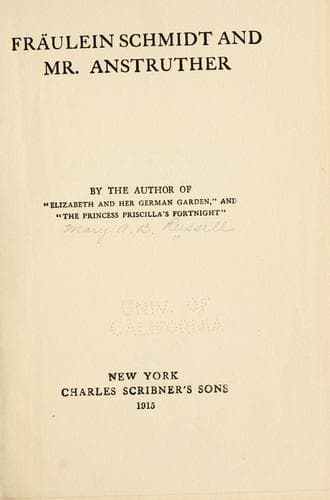
Fräulein Schmidt and Mr. AnstrutherVon Arnim, Elizabeth
General
Fräulein Schmidt and Mr. Anstruther
Von Arnim, Elizabeth
British -- Germany -- Fiction; Epistolary fiction; Germany -- Fiction; Love stories; Young women -- Fiction
Well, I am preaching. I would make a very arrogant parson, wouldn't I,
laying down the law more often than the prophets from that safe citadel,
a pulpit; but please have patience, for I want you to comfort me. The
book really has made me unhappy. It is the kind of book you must go on
reading,--angry, rebelling at every page, but never leaving it till
you've reached the last word. Then you throw it as hard as you can into
the furthest corner of the room, and shake yourself as a dog does, come
up out of muddy water, and think to shake it off as easily as he does
his mud; but you can't, because it has burned itself into your soul. I
don't suppose you will understand what I feel. When a person possesses
very few things those few things are terribly precious. See the mother
of the only child, and compare her conduct when it coughs with the
conduct of the mother of six, all coughing. See how one agonizes; and
see with what serenity the other brings out her bottle of mixture and
pours it calmly down her children's throats. Well, I'm like the first
mother, and you are like the second. I expect you knew long ago, and
have never minded knowing, the littlenesses of my gods; but I, I felt as
unsettled while I read about them, as uneasy, as fidgety, as frightened,
as a horse being driven by somebody cruel, which knows that every minute
the lash will come down in some fresh place. Think: I knew nothing about
Harriet Westbrook and her tragic life and death; I had never heard of
Emilia Viviani; of Mary; of her whose name was Eliza, but who soared
aloft in the sunshine of Shelley's admiration re-christened Portia, only
presently to descend once more into the font and come out luridly as the
Brown Demon. I never knew that Keats loved somebody called Brawne, and
that she was unwilling, that she saw little in him, in Endymion the
godlike, the divinely gifted, and that he was so persistent, so
unworthily persistent, that the only word I can find that at all
describes it is the German _zappelnd._ I had never heard of Jean Armour,
of the headlong descent from being 'him who walked in glory and in joy,
Following his plough along the mountain-side' to hopeless black years
spent in public-houses at the beck and call--think of it, think of the
divine spirit forced to it by its body--of any one who would pay for a
drink. I never knew about Coleridge's opium, or that to Carlyle he
appeared as a helpless Psyche overspun with Church of England cobwebs,
as a weak, diffusive, weltering, ineffectual man. I never knew that
Wordsworth's greeting was a languid handful of numb, unresponsive
fingers, that his speech was prolix, thin, endlessly diluted. I never
knew that Milton had three wives, that the first one ran away from him a
month after their marriage, that he was hard to his daughters, so hard
that they wished him dead. All these things I never knew; and for years
I have been walking with glorious spirits, and have been fed on
honey-dew, and drunk the milk of Paradise.
Public-domain text, read in full here on John Shaqi.
Reviews
Reviews
No reviews yet
Be the first to share your thoughts on this work.
Elsewhere in the archive
Join the Discussion
Join the discussion
Sign in to leave a comment or review.
Sign InorCreate an account