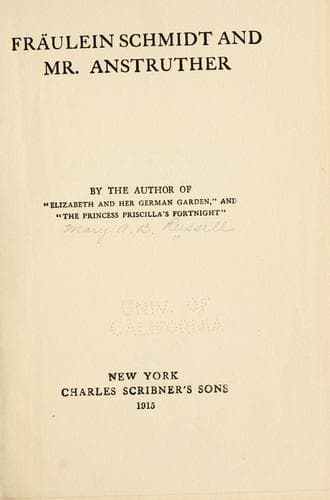
Fräulein Schmidt and Mr. AnstrutherVon Arnim, Elizabeth
General
Fräulein Schmidt and Mr. Anstruther
Von Arnim, Elizabeth
British -- Germany -- Fiction; Epistolary fiction; Germany -- Fiction; Love stories; Young women -- Fiction
While I copy he comes in and out to ask me where I have got to and if I
like it. I assure him that I think it delightful, and so honestly I do
in a way, but I don't think it will be the public's way. It begins by
telling the reader, presumably a person in search of information about
Goethe, that Jena is a town of twenty thousand inhabitants, of whom
nineteen thousand are apparently professors. The town certainly does
give you that impression as you walk about its little streets and at
every corner meet the same battered-looking persons in black you met at
the corner before, but what has that to do with Goethe? And the pages
that follow have nothing to do with him either that I can see, being a
disquisition on the origin and evolution of the felt hats the professors
wear--dingy, slouchy things--winding up with an explanation of their
symbolism and inevitableness, based on a carefully drawn parallel
between them and the kind of brains they have to cover. From this point,
the point of the head-wear of the learned in our present year, he has to
work back all the way to Goethe in Jena a century ago. It takes him
several chapters to get back, for he doesn't go straight, being
constitutionally unable to resist turning aside down the green lanes of
moralizing that branch so seductively off the main road and lead him at
last very far afield; and when he does arrive he is rather breathless,
and flutters for some time round the impassive giant waiting to be
described, jerking out little anecdotes, very pleasant little anecdotes,
but quite unconnected with his patient subject, before he has got his
wind and can begin.
He is rosy with hope about this book. 'All Jena will read it,' he says,
'because they will like to hear about themselves'--I wonder if they
will--'and all Germany will read it because it will like to hear about
Goethe.'
'It has heard a good deal about him already, you know Papachen,' I say,
trying gently to suggest certain possibilities.
'England might like to have it. There has been nothing since that man
Lewes, and never anything really thorough. A good translation,
Rose-Marie--what do you think of that as an agreeable task for you
during the approaching winter evenings? It is a matter worthy of
consideration. You will like a share in the work, a finger in the
literary pie, will you not?'
'Of course I would. But let me copy now, darling. I'm not half through.'
Public-domain text, read in full here on John Shaqi.
Reviews
Reviews
No reviews yet
Be the first to share your thoughts on this work.
Elsewhere in the archive
Join the Discussion
Join the discussion
Sign in to leave a comment or review.
Sign InorCreate an account