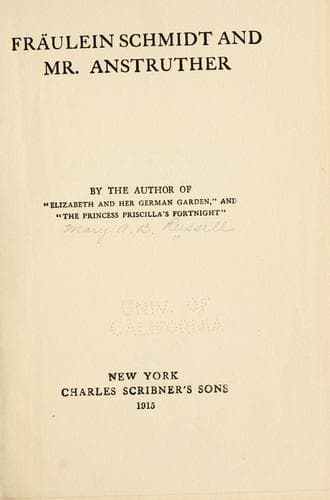
Fräulein Schmidt and Mr. AnstrutherVon Arnim, Elizabeth
General
Fräulein Schmidt and Mr. Anstruther
Von Arnim, Elizabeth
British -- Germany -- Fiction; Epistolary fiction; Germany -- Fiction; Love stories; Young women -- Fiction
respectful hand, has begun to unbend, to unfold, to expand like those
Japanese dried flowers you fling into water; and having started with
good mornings and weather comments and politics, and from them proceeded
to the satisfactorily confused state of the British army, has gone on
imperceptibly but surely to confidential criticisms of the mistakes made
here at headquarters in invariably shelving the best officers at the
very moment when they have arrived at what he describes as their prime,
and has now reached the stage when he comes up through the orchard every
morning at the hour I am due for my lesson to help me over the fence. He
comes up with much stateliness and deliberation, but he does come up;
and we walk down together, and every day the volume of his confidences
increases and he more and more minutely describes his grievances. I
listen and nod my head, which is easy and apparently all he wants. His
wife stops him at once, if he begins to her, by telling him with as much
roundness as is consistent with being born a Dammerlitz that the
calamities that have overtaken them are entirely his fault. Why was he
not as clever as those subordinates who were put over his head? she asks
with dangerous tranquillity; and nobody can answer a question like that.
'It makes me twenty years younger,' he said yesterday as he handed me
over the fence with the same politeness I have seen in the manner of old
men handing large dowagers to their places in a set of quadrilles, 'to
see your cheerful morning face.'
'If you had said shining morning face you'd have been quoting
Shakespeare,' said I.
'Ah yes. I fear my Shakespeare days are done. I am now at the time of
life when serious and practical considerations take up the entire
attention of a man. Shakespeare is more suitable now for my daughter
than for me.'
'But clever men do read him.'
'Ah yes.'
'Quite grown-up ones do.'
'Ah yes.'
'With beards.'
'Ah yes.'
'Real men.'
'Ah yes, yes. Professors. Theatre people. People of no family. People
who have no serious responsibilities on their shoulders. People of the
pen, not men of the sword. But officers--and who in our country of the
well-born is not, was not, or will not be an officer?--have no time for
general literature. Of course,' he added with a slight bow, for he
regards me as personally responsible for everybody and everything
English--'we have all heard of him.'
'Indeed?' said I.
'When I was a boy,' he said this morning, 'I read at school of a young
woman--a mythological person--called Hebe.'
'She was the daughter of Juno and wild lettuce,' said I.
'It may be,' he said. 'The parentages of the mythological period are
curiously intricate. But why is it, dear Fräulein Schmidt, that though I
can recollect nothing of her but her name, whenever I see you you remind
me of her?'
Public-domain text, read in full here on John Shaqi.
Reviews
Reviews
No reviews yet
Be the first to share your thoughts on this work.
Elsewhere in the archive
Join the Discussion
Join the discussion
Sign in to leave a comment or review.
Sign InorCreate an account