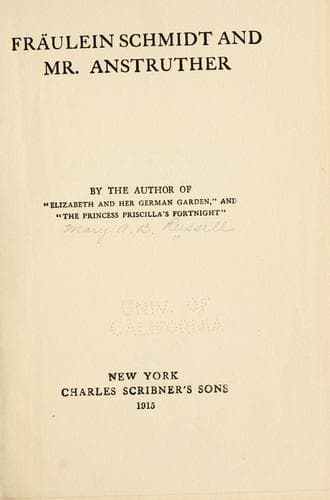
Fräulein Schmidt and Mr. AnstrutherVon Arnim, Elizabeth
General
Fräulein Schmidt and Mr. Anstruther
Von Arnim, Elizabeth
British -- Germany -- Fiction; Epistolary fiction; Germany -- Fiction; Love stories; Young women -- Fiction
spirit taking visible form; either they are that, or they are, I
suppose, God's ideas--after all the same thing put into shapes we can
see and touch. So that it's not so dreadful of me to like them best, to
prefer their company, their silent teaching, although you will I know
lecture me and perhaps tell me I am petrifying into a mere thing myself.
Well, it is only fair that you should lecture me, who so often lecture
you.
Yours quite meekly,
ROSE-MARIE SCHMIDT.
LIII
Galgenberg, Nov. 1st.
Dear Mr. Anstruther,--I won't talk about it any more. Let us have done
with it. Let us think of something else. I shall get tired of the duke
if you are not careful, so please save me from an attitude so
unbecoming. This is All Saints' Day: the feast of white chrysanthemums
and dear memories. My mother used to keep it as a day apart, and made me
feel something of its mysticalness. She had a table in her bedroom, the
nearest approach that was possible to an altar, with one of those
pictures hung above it of Christ on the Cross that always make me think
of Swinburne's
God of this grievous people, wrought
After the likeness of their race--
do you remember?--and candles, and jars of flowers, and many little
books; and she used on her knees to read in the little books, kneeling
before the picture. She explained to me that the Lutheran whitewash
starved her soul, and that she wanted, however clumsily, to keep some
reminder with her of the manner of prayer in England. Did I ever tell
you how pretty she was? She was so very pretty, and so adorably nimble
of tongue. Quick, glancing, vivid, she twinkled in the heavy Jena
firmament like some strange little star. She led Papa and me by the
nose, and we loved it. I can see her now expounding her rebellious
theories, sitting limply--for she was long and thin--in a low chair, but
with nothing limp about her flower-like face and eyes shining with
interest in what she was talking about. She was great on the necessity,
a necessity she thought quite good for everybody but absolutely
essential for a woman, of being stirred up thoroughly once a week at the
very least to an enthusiasm for religion and the life of the world to
come. She said there was nothing so good for one as being stirred up,
that only the well stirred ever achieve great things, that stagnation
never yet produced a soul that had shot up out of reach of fogs on to
the clear heights from which alone you can call out directions for the
guidance of those below. The cold, empty Lutheran churches were
abhorrent to her. 'They are populated on Sundays,' she said, 'solely by
stagnant women,--women so stagnant that you can almost see the duckweed
growing on them.'
Public-domain text, read in full here on John Shaqi.
Reviews
Reviews
No reviews yet
Be the first to share your thoughts on this work.
Elsewhere in the archive
Join the Discussion
Join the discussion
Sign in to leave a comment or review.
Sign InorCreate an account