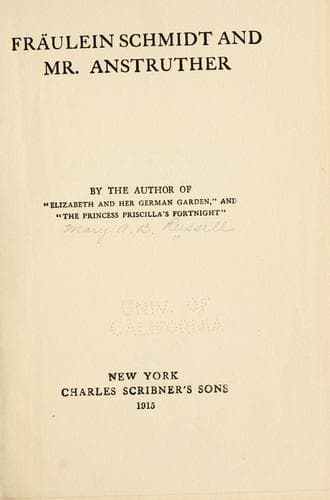
Fräulein Schmidt and Mr. AnstrutherVon Arnim, Elizabeth
General
Fräulein Schmidt and Mr. Anstruther
Von Arnim, Elizabeth
British -- Germany -- Fiction; Epistolary fiction; Germany -- Fiction; Love stories; Young women -- Fiction
to gaze upon him between two museums--and wears a black coat on weekdays
as well as on Sundays, which greatly dazzled my step-mother, who was
with us. I believe he is eminently respectable, and the bank values him
as an old and reliable servant, and has made him rich. His salary is
eight thousand marks a year--four hundred pounds, sir; four times as
much as what we have--and my step-mother used often and fervently to
wish that Papa had been more like him. I thought him a terrifying old
uncle, a parched, machine-like person, whose soul seemed withdrawn into
unexplorable vague distances, reduced to a mere far-off flicker by the
mechanical nature of his work. He is ten years younger than Papa, but
infinitely more faded. He never laughs. He never even smiles. He is rude
to his wife. He is withering to his daughters. He made me think of owls
as he sat at supper that night in his prim clothes, with round gloomy
eyes fixed on Papa, whom he was lecturing. Papa didn't mind. He had had
a happy day, ending with two very glorious hours in the Royal Library,
and Tante Else's herring salad was much to his taste. 'Hast thou no
respect, Heinrich,' he cried at last when my uncle, warmed by beer, let
his lecture slide over the line that had till then divided it from a
rating, 'hast thou then no respect for the elder brother, and his white
and reverend hairs?'
But Onkel Heinrich, aware that he is the success and example of the
family, and as intolerant as successes and examples are of laxer and
poorer relations, waved Papa's banter aside with contempt, and proposed
that instead of wasting any more of an already appallingly wasted life
in idle dabblings in so-called literature he too should endeavor to get
a post, however humble, in a bank in Berlin, and mend his ways, and earn
an income of his own, and cease from living on an income acquired by
marriages.
My step-mother punctuated his words with nods of approval.
'What, as a doorkeeper, eh, thou cistern filled with wisdom?' cried
Papa, lifting his glass and drinking gayly to Tante Else, who glanced
uneasily at her husband, he not yet having been, to her recollection,
called a cistern.
'It is better,' said my step-mother, to whom a man so punctual, so
methodical, and so well-salaried as Onkel Heinrich seemed wholly ideal,
'it is better to be a doorkeeper in--in-'
She was seized with doubt as to the applicability of the text, and
hesitated.
'A bank?' suggested Papa pleasantly.
'Yes, Ferdinand, even in a bank rather than dwell in the tents of
wickedness.'
'That,' explained Papa to Tante Else, leaning back in his chair and
crossing his hands comfortably over what, you being English, I will call
his chest, 'is my dear wife's poetic way--'
'Scriptural way, Ferdinand,' interrupted my step-mother. 'I know no
poetic ways.'
'It is the same thing, _meine Liebste_. The Scriptures are drenched in
poetry. Poetic way, I say, of referring to Jena.'
Public-domain text, read in full here on John Shaqi.
Reviews
Reviews
No reviews yet
Be the first to share your thoughts on this work.
Elsewhere in the archive
Join the Discussion
Join the discussion
Sign in to leave a comment or review.
Sign InorCreate an account