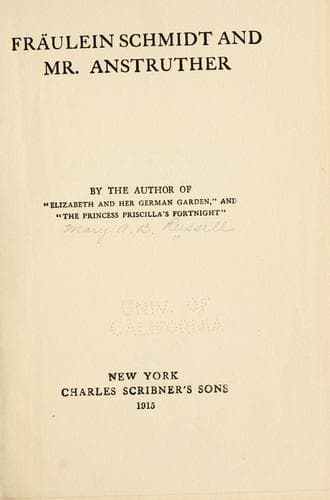
Fräulein Schmidt and Mr. AnstrutherVon Arnim, Elizabeth
General
Fräulein Schmidt and Mr. Anstruther
Von Arnim, Elizabeth
British -- Germany -- Fiction; Epistolary fiction; Germany -- Fiction; Love stories; Young women -- Fiction
'Ach, Fräulein Schmidt,' said he, suddenly perceiving me. 'Good evening.
A fine evening. I did not know I had an audience.'
'Yes,' said I, unable at once to adjust myself to politenesses.
'Do you like music?'
'Yes,' said I, still vibrating.
'It is a good violin. I picked it up--' and he told me a great many
things that I did not hear, for how can you hear when your spirit
refuses to come back from its journeyings among the stars?
'Will you not enter?' he said at last. 'My mother is fetching up some
beer and will be here in a moment. It makes one warm playing.'
But I would not enter. I walked back slowly through the long orchard
grass between the apple-trees trees. The moon gleamed along the
branches. The branches were weighed down with apples. The place was full
of the smell of fruit, of the smell of fruit fallen into the grass, that
had lain there bruised all day in the sun. I think the beauty of the
world is crushing. Often it seems almost unbearable, calling out such an
acuteness of sensation, such a vivid, leaping sensitiveness of feeling,
that indeed it is like pain.
But what I want to talk about is the strange way good things come out of
evil. It really almost makes you respect and esteem the bad things,
doing it with an intelligent eye fixed on the future. Here is our young
friend down the hill, a young man most ordinary in every way but one, so
ordinary that I think we must put him under the heading bad, taking bad
in the sense of negation, of want of good, here he is, robust of speech,
fond of beer, red of tie, chosen as her temple by that delicate lady the
Muse of melody. Apparently she is not very particular about her temples.
It is true while he is playing at her dictation she transforms him
wholly, and I suppose she does not care what he is like in between. But
I do. I care because in between he thinks it pleasant to entertain me
with facetiousness, his mother hanging fondly on every word in the
amazing way mothers, often otherwise quite intelligent persons, do.
Since that first evening he has played every evening, and his taste in
music is as perfect as it is bad in everything else. It is severe,
exquisite, exclusive. It is the taste that plays Mozart and Bach and
Beethoven, and wastes no moments with the Mendelssohn sugar or the
lesser inspiration of Brahms. I tried to strike illumination out of him
on these points, wanted to hear his reasons for a greater exclusiveness
than I have yet met, went through a string of impressive names beginning
with Schumann and ending with Wagner and Tchaikowsky, but he showed no
interest, and no intelligence either, unless a shrug of the shoulder is
intelligent. It is true he remarked one day that he found life too short
for anything but the best--'That is why,' he added, unable to forbear
from wit, 'I only drink Pilsner.'
'What?' I cried, ignoring the Pilsner, 'and do not these great
men'--again I ran through a string of them--'do not they also belong to
the very best?'
Public-domain text, read in full here on John Shaqi.
Reviews
Reviews
No reviews yet
Be the first to share your thoughts on this work.
Elsewhere in the archive
Join the Discussion
Join the discussion
Sign in to leave a comment or review.
Sign InorCreate an account