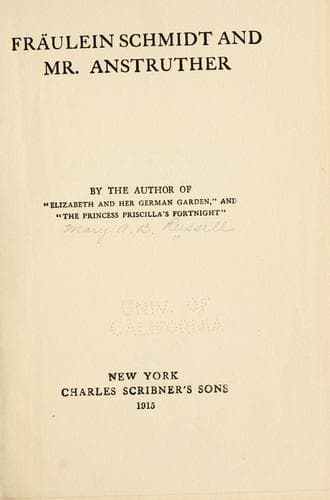
Fräulein Schmidt and Mr. AnstrutherVon Arnim, Elizabeth
General
Fräulein Schmidt and Mr. Anstruther
Von Arnim, Elizabeth
British -- Germany -- Fiction; Epistolary fiction; Germany -- Fiction; Love stories; Young women -- Fiction
Do my plans seem to you selfish? I expect they do. People so easily call
those selfish who stand a little aside and look on at life. We have a
poet of whom we are proud, but whose fame has not, I think, reached
across to England, a rugged, robust poet, not very far below Goethe, a
painter on large canvasses, best at mighty scenes, perhaps least good in
small things, in lyrics, in the things in which Heine was so exquisite;
and he for my encouragement has said,
Bei sich selber fangt man an,
Da man nicht Allen helfen kann.
Isn't it a nice jingle? The man's name is Hebbel, and he lived round
about the forties, and perhaps you know more of him than I do, and I
have been arrogant again; but it is a jingle that has often cheered me
when I was afraid I ought to be teaching somebody something, or making
clothes for somebody, or paying somebody domiciliary visits and talking
fluently of the _lieber Gott_. I shrink from these things; and a
shrinking visitor, shy and uncertain, cannot be so nice as no visitor at
all. Is it very wrong of me? When my conscience says it is--it does not
say so often--I try to make up by going into the kitchen and asking
Johanna kind questions about her mother. I must say she is rather odd
when I do. She not only doesn't meet me half-way, she doesn't come even
part of the way. She clatters her saucepans with an energy very like
fury, and grows wholly monosyllabic. Yet it is not her step-mother; it
is her very own mother, and it ought to be the best way of touching
responsive chords in her heart and making her feel I am not merely a
mistress but a friend. Once, struck by the way the lids of the saucepans
were falling about, I tried her with her father, but the din instantly
became so terrific that I was kept silent quite a long time, and when it
left off felt instinctively that I had better say something about the
weather. I don't think I told you that after that trumpeting Sunday,
moved to real compassion by the sufferings of him you call the fiddler
man, I took my courage in both hands and told Johanna with the
pleasantest of smiles--I daresay it was really a rather ghastly
one--that her trumpeter must not again bring his instrument with him
when he called. 'It can so very well stay at home,' I explained suavely.
She immediately said she would leave on the first of October.
'But, Johanna!' I cried.
She repeated the formula.
'But, Johanna! How can a clever girl like you be so unreasonable? He is
to visit you as often as before. All we beg is that it shall be done
without music.'
She repeated the formula.
'But, Johanna!' I expostulated again,--eloquent exclamation, expressing
the most varied sentiments.
She once again repeated the formula; and next day I was forced to
descend into Jena, shaking an extremely rueful fist at the neighbor's
house on the way, and set about searching in the obscurity of a registry
office for the pearl we are trying all our lives to find.
Public-domain text, read in full here on John Shaqi.
Reviews
Reviews
No reviews yet
Be the first to share your thoughts on this work.
Elsewhere in the archive
Join the Discussion
Join the discussion
Sign in to leave a comment or review.
Sign InorCreate an account