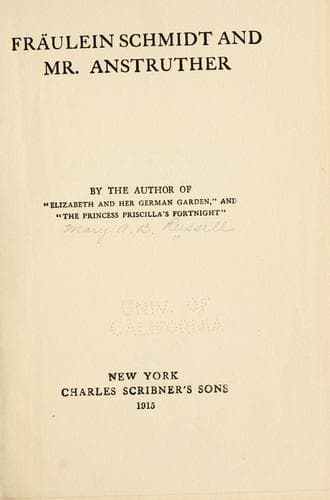
Fräulein Schmidt and Mr. AnstrutherVon Arnim, Elizabeth
General
Fräulein Schmidt and Mr. Anstruther
Von Arnim, Elizabeth
British -- Germany -- Fiction; Epistolary fiction; Germany -- Fiction; Love stories; Young women -- Fiction
But see how true it sometimes is that virtue is rewarded. Johanna went
down as I had promised, and worked all day for Frau Meyer. She was given
a thaler as a present, as much cake and coffee as she could consume, and
received the offer of a permanent engagement when she should leave us.
This she told me standing by my bedside late that night, the candle in
her hand lighting up her heated, shining face, and hair dishevelled by
exertion. 'But,' said she, 'Fräulein Rose-Marie, not for the world would
I take the place. Such a restless lady, such a nervous gentleman, such
numbers of spoilt and sprawling children. If I had not been there today
and beheld it from the inside I would have engaged myself to go. But
after this--' she waved the candle--'never.'
'What are you going to do, then, Johanna?' I asked, thinking wistfully
of the four years we had passed together.
'Stay here,' she announced defiantly.
I put my arms round her neck and kissed her.
Yours sincerely,
ROSE-MARIE SCHMIDT.
XLV
Galgenberg, Sept. 23d.
Dear Mr. Anstruther,--Today I went down to Jena with the girl from next
door who wanted to do such mild shopping as Jena is prepared for, mild
shopping suited to mild purses, and there I drifted into the bookshop in
the market-place where I so often used to drift, and there I found a
book dealing with English poetry from Chaucer onward, with pictures of
the poets who had written it. But before I go on about that--and you'll
be surprised at the amount I have to say--I must explain the girl next
door. I don't think I ever told you that there is one. The neighbor let
his house just before he left, and let it unexpectedly well, the people
taking the upper part of it for a whole year, and this is their
daughter. The neighbor went off jubilant to his little inky boys. 'See,'
said he at parting, 'my life actually threatens to become rich without
as well as within.'
'Don't,' I murmured, turning as hot as people do when they are reminded
of past foolishness.
The new neighbors have been here ten days, and I made friends at once
with the girl over the fence. She saw me gathering together into one
miserable haycock the September grass Johanna and I had been hacking at
in turns with a sickle for the last week, and stood watching me with so
evident an interest that at last I couldn't help smiling at her. 'This
is our crop for the winter,' I said, pointing to the haycock; I protest
I have seen many a molehill bigger.
'It isn't much,' said the girl.
'No,' I agreed, raking busily.
'Have you a cow?' she asked.
'No.'
'A pig?'
'No.'
'No animals?'
'Bees.'
The girl was silent; then she said bees were not animals.
'But they're live-stock,' I said. 'They're the one link that connects us
with farming.'
'What do you make hay for, then?'
'Only to keep the grass short, and then we try to imagine it's a lawn.'
Raking, I came a little nearer; and so I saw she had been, quite
recently, crying.
Public-domain text, read in full here on John Shaqi.
Reviews
Reviews
No reviews yet
Be the first to share your thoughts on this work.
Elsewhere in the archive
Join the Discussion
Join the discussion
Sign in to leave a comment or review.
Sign InorCreate an account