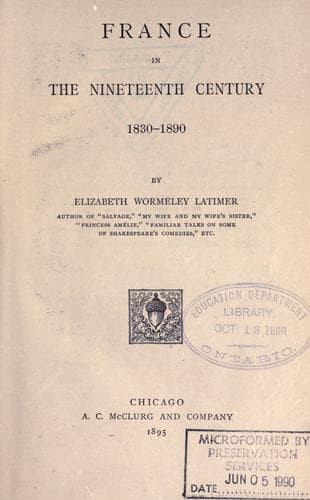
France in the Nineteenth CenturyLatimer, Elizabeth Wormeley
History
France in the Nineteenth Century
Latimer, Elizabeth Wormeley
France -- History -- 1789-1900
The Assembly was now dissolved, and a new Chamber of Deputies was
to be chosen in June. Among the candidates for election was Prince
Louis Napoleon. He had already, in the days of Lamartine's
administration, visited Paris, and had replied to a polite request
from the provisional Government that he would speedily leave the
capital, that any man who would disturb the Provisional Government
was no true friend to France. Now he professed to ask only to be
permitted to become a representative of the people, saying that he
had "not forgotten that Napoleon, before being the first magistrate
in France, was its first citizen."
Then cries of "Vive l'empereur!" began to be heard. Louis Napoleon's
earliest "idea" had been that France needed an emperor whose throne
should be based on universal suffrage. To this "idea" he added
another,--that it was _his_ destiny to be the chosen emperor.
No one in these days can conceive the hold that the memory of the
First Napoleon had, in 1848, on the affections of the French people.
That he put down anarchy with an iron hand was by the Anarchists
forgotten. He was a son of the Revolution. His marches through
Europe had scattered the seeds of revolutionary ideas. The heart
of France responded to such verses as Béranger's "Grand'-mère." In
vain Lamartine represented the impolicy and unfairness of proscribing
the Orleans family while admitting into France the head of the house
of Bonaparte. Louis Napoleon was elected deputy by four departments;
but he subsequently hesitated to take his seat, fearing, he said,
that he might be the cause of dissension in the Assembly.
The deputies from Paris were all Socialists, but those from the
departments were frequently men of note and reputation. The country
members were nearly all friends to order and conservatism.
The first necessary measure was to get rid of the national workshops.
On June 20, one hundred and twenty thousand workmen were being paid
daily two francs each, only two thousand of whom had anything to
do, while fifty thousand more were clamoring for admission.
Of course any measure to suppress the national workshops, or to
send home those who had come up to Paris for employment in them, was
opposed by the workmen. It was computed that among those employed,
or rather paid, by the State for doing nothing, were twenty-five
thousand desperate men, ready for any fight, and that half this
number were ex-convicts. The Government had nominally large forces
at its command, but it was doubtful how far its troops could be
relied on.
Public-domain text, read in full here on John Shaqi.
Reviews
Reviews
No reviews yet
Be the first to share your thoughts on this work.
Elsewhere in the archive
Join the Discussion
Join the discussion
Sign in to leave a comment or review.
Sign InorCreate an account