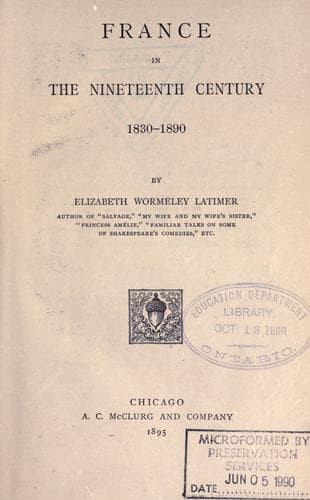
France in the Nineteenth CenturyLatimer, Elizabeth Wormeley
History
France in the Nineteenth Century
Latimer, Elizabeth Wormeley
France -- History -- 1789-1900
As a deputy, before his election by the country as its president,
he used to sit in the Chamber silent and alone, pitied by some, and
neglected by all. Silence, indeed, was necessary to his success, for,
"silent and smoking, he matured his plans." One of the first things
he did when he became president was to attempt to get possession of
all papers in the archives concerning his conduct at Strasburg
and Boulogne.
There had been a new Assembly elected. It had few of the old republican
leaders in it, but the Left and the Right and half the Centre were
opposed to the prince president. The Left in the French Chamber
means the Red Republicans; the Right, those members who are in
favor of monarchy; the Centre, the Moderates, who are willing to
accept any good government.
One of the objects of this Assembly, which foresaw that a _coup
d'état_ might be at hand, was to get command of a little army for
its own protection. It appointed as commander of this force General
Changarnier, with whom the prince president had recently quarrelled,
and designated four of its members, whom it called _quoestors_, to
look into all matters relating to its safety.
The constitution was to be revised by this Assembly. Nobody cared
much about the constitution, which had not had time to acquire any
hold on the affections of the people, and Louis Napoleon had recently
acquired popularity with the turbulent part of the population of Paris
by opposing a measure calculated to restrict universal suffrage, and
to prevent tramps, aliens, and ex-convicts from voting at elections.
The prince president, who wanted, for his own purposes, as large
a popular vote as possible, was opposed to any restrictions on
the suffrage.
Such was the condition of things on Nov. 26, 1851, when Louis Napoleon
summoned the principal generals and colonels of the troops in and
around Paris to meet him at the Élysée. At this meeting they all
swore to support the president if called upon to do so, and never
to tell of this engagement. They kept the secret for five years.
Meantime the Assembly on its part was hatching a conspiracy to
overturn the president and send him to a dungeon at Vincennes;
while all who refused to support its authority were to be declared
guilty of treason.
The three men called the generals of the Army of Africa,--namely,
Cavaignac, Changarnier, and Lamoricière,--were opposed to the prince
president. They were either Republicans or Orleanists.
Thus the crisis approached. Each party was ready to spring upon
the other. Again France was to experience a political convulsion,
and the party that moved first would gain the day.
CHAPTER VIII.
THE COUP D'ÉTAT.
Public-domain text, read in full here on John Shaqi.
Reviews
Reviews
No reviews yet
Be the first to share your thoughts on this work.
Elsewhere in the archive
Join the Discussion
Join the discussion
Sign in to leave a comment or review.
Sign InorCreate an account