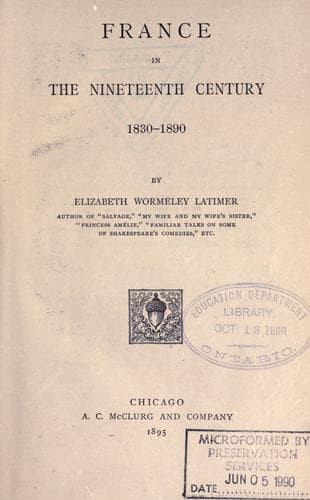
France in the Nineteenth CenturyLatimer, Elizabeth Wormeley
History
France in the Nineteenth Century
Latimer, Elizabeth Wormeley
France -- History -- 1789-1900
The world, to all appearance, went on in its usual way. The Assembly,
on December 1, 1851, was busy discussing the project of a railroad
to Lyons. That evening M. de Morny was at the Opéra Comique in
company with General Changarnier, and the prince president was
doing the honors as usual in his reception-room at the Élysée. His
visage was as calm, his manners were as conciliatory and affable,
as usual. No symptoms of anything extraordinary were to be seen,
and an approaching municipal election in Paris accounted for the
arrival of several _estafettes_ and couriers, which from time to
time called the prince president from the room. When the company
had taken leave, Saint-Arnaud, Maupas, Morny, and a colonel on
the staff went with the prince president into his smoking-room,
where the duties of each were assigned to him. Everything was to be
done by clock-work. Exactly at the hour appointed, all the African
generals and several of their friends were to be arrested. Exactly
at the moment indicated, troops were to move into position. At so
many minutes past six A. M. all the printing-offices were to be
surrounded. Every man who had in any way been prominent in politics
since the days of Louis Philippe was to be put under arrest.
By seven o'clock in the morning all this had been accomplished.
The Parisians awoke to find their walls placarded by proclamations
signed by Prince Louis Napoleon as President, De Morny as Minister
of the Interior, De Maupas as Prefect of Police, and Saint-Arnaud
as Minister of War.
These proclamations announced,--
I. The dissolution of the Assembly.
II. The restoration of universal suffrage.
III. A general election on December 14.
IV. The dissolution of the Council of State.
V. That Paris was in a state of siege.
This last meant that any man might be arrested, without warrant,
at the pleasure of the police.
Another placard forbade any printer, on pain of death, to print
any placard not authorized by Government; and death likewise was
announced for anyone who tore down a Government placard.
Louis Napoleon followed this up by an appeal to the people. He said
he wished the people to judge between the Assembly and himself.
If France would not support him, she must choose another president.
In place of the constitution of 1848 he proposed one that should
make the presidential term of office ten years; he also proposed
that the president's cabinet should be of his own selection.
Louis Napoleon had entire confidence that all elections by universal
suffrage would be in his favor. He had just made extensive tours in
the provinces, and had been received everywhere with enthusiasm.
Thus far I have given the historical outline of the story; but if
we look into Victor Hugo's "Histoire d'un Crime," and disentangle
its facts from its hysterics, we may receive from his personal
narrative a vivid idea of what passed in Paris from the night of
Dec. 1, 1851, to the evening of December 4, when all was over.
Public-domain text, read in full here on John Shaqi.
Reviews
Reviews
No reviews yet
Be the first to share your thoughts on this work.
Elsewhere in the archive
Join the Discussion
Join the discussion
Sign in to leave a comment or review.
Sign InorCreate an account