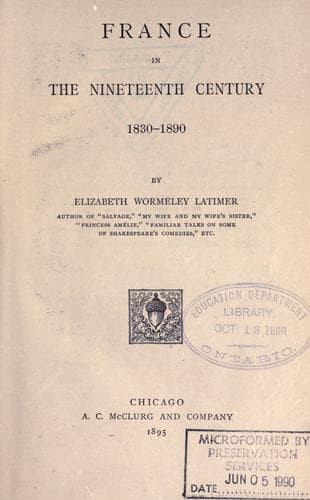
France in the Nineteenth CenturyLatimer, Elizabeth Wormeley
History
France in the Nineteenth Century
Latimer, Elizabeth Wormeley
France -- History -- 1789-1900
Meantime, from early morning the hall of the representatives had
been surrounded by soldiers with mortars and cannon. As the deputies
arrived they were allowed to pass the gates, but were not permitted
to enter their chamber. Their president, or Speaker, M. Dupin, was
appealed to. He said he could do nothing; it was hopeless to resist
such a display of force. At last the representatives, becoming,
as the soldiers put it, "noisy and troublesome," were collared
and turned out into the street. One by one the most excited were
arrested. The remainder decided to go to the High Court of Justice
and demand a warrant to depose and arrest the prince president.
But they could not find the judges; they had hidden themselves
away. When at last they succeeded in discovering the place where
they were sitting, the police followed closely on their track,
and the judges were forced to shut up their court and march off,
under a guard of soldiers.
The representatives then decided to go to the Mairie of the Tenth
Arrondissement, and there reorganize into a legislative body. They
were nearly all members belonging to the Right, but they were as
indignant as the Left at the outrage.
They formed into a column, marching two and two abreast; but the
Left would not march with the Right, so they proceeded in two parallel
columns, one on each side of the way. Arrived at the Mairie, they made
Jules de Lasteyrie, Lafayette's grandson, president _pro tempore_, and
proceeded to pass a decree deposing Louis Bonaparte. Scarcely was this
done when a battalion of cavalry arrived, and the legislators soon
perceived that they were prisoners. After a great deal of altercation
with the soldiers, they were marched off to a barrack-yard on the
Quai d'Orsay.
When all this was reported to De Morny, he remarked: "It is well;
but they are the last deputies who will be made _prisoners_,"--meaning
that any others would be shot.
It was half-past three when the deputies were locked into the
barrack-yard. The December day was cold and frosty, the sky overcast.
The first thing they did was to call the roll. There were two hundred
and twenty of them, out of a total membership of seven hundred
and fifty. Among them were many of the best and most conservative
men of France. There was Jules Grévy, the future president (M.
Thiers was already in prison); Jules de Lasteyrie; Sainte-Beuve,
the great critic; Berryer, the great lawyer; the Duc de Luynes,
the richest man in France; and Odillon Barrot, the popular idol
at the commencement of the late revolution. De Tocqueville was
there, the great writer on America; General Oudinot, and several
other generals; the Duc de Broglie, great-grandson of Madame de
Staël; Eugène Sue, the novelist; Coquerel, the French Protestant
preacher; and M. de Rémusat, the son of that lady who has given
us her experiences of the court of the First Napoleon.
Public-domain text, read in full here on John Shaqi.
Reviews
Reviews
No reviews yet
Be the first to share your thoughts on this work.
Elsewhere in the archive
Join the Discussion
Join the discussion
Sign in to leave a comment or review.
Sign InorCreate an account