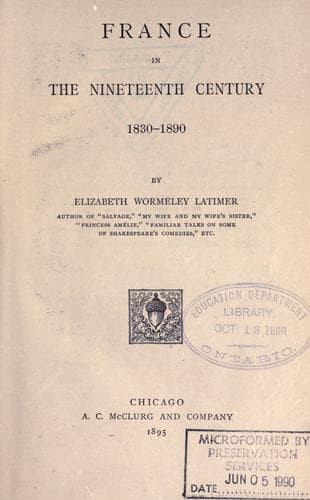
France in the Nineteenth CenturyLatimer, Elizabeth Wormeley
History
France in the Nineteenth Century
Latimer, Elizabeth Wormeley
France -- History -- 1789-1900
The next morning all Paris was astir to see the wedding procession
pass to the cathedral of Notre Dame. Early in the morning the emperor
had repaired to the Élysée, where, in the chapel, he and the empress
had heard mass, and after making their confession, had partaken
of the Holy Communion. There were two hundred thousand sightseers
in Paris that day, in addition to the usual population.
The empress wore upon her golden hair the crown that the First
Napoleon had placed upon the head of Marie Louise. The body of
the church was filled with men,--ambassadors, military and naval
officers, and high officials. Their wives were in the galleries.
As the great doors of the cathedral were opened to admit the bridal
procession, a broad path of light gleamed from the door up to the
altar, adding additional brilliancy to the glittering scene. Up
the long aisle the emperor led his bride, flashing with the light
of jewels, among them the unlucky regent diamond, which glittered
on her bosom. After the Spanish fashion, she crossed her brow,
her lips, her heart, her thumb, as she knelt for the nuptial
benediction. The ceremony over, the archbishop conducted the married
pair to the porch of the cathedral, and they drove along the Quai
to the Tuileries.
The first favor the empress asked of her husband was the pardon
of more than four thousand unfortunate persons still exiled or
imprisoned for their share in the risings that succeeded the _coup
d'état_.
When Washington Irving heard of the marriage, he wrote: "Louis
Napoleon and Eugénie de Montijo,--Emperor and Empress of France!
He whom I received as an exile at my cottage on the Hudson, she
whom at Granada I have dandled on my knee! The last I saw of Eugénie
de Montijo, she and her gay circle had swept away a charming young
girl, beautiful and accomplished, my dear young friend, into their
career of fashionable dissipation. Now Eugénie is on a throne,
and the other a voluntary recluse in a convent of one of the most
rigorous Orders." This convent is near Biarritz, where the nuns
take vows of silence like the monks of La Trappe.[1] The empress
when at Biarritz never failed to visit her former friend, who was
permitted to converse with her.
[Footnote 1: Saturday Review, 1885.]
Public-domain text, read in full here on John Shaqi.
Reviews
Reviews
No reviews yet
Be the first to share your thoughts on this work.
Elsewhere in the archive
Join the Discussion
Join the discussion
Sign in to leave a comment or review.
Sign InorCreate an account