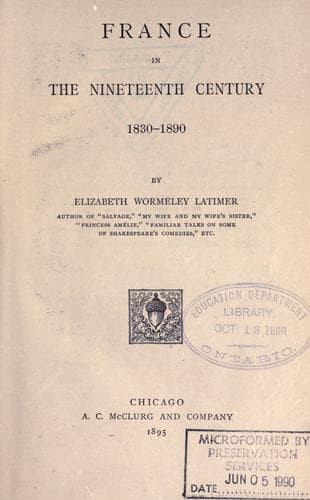
France in the Nineteenth CenturyLatimer, Elizabeth Wormeley
History
France in the Nineteenth Century
Latimer, Elizabeth Wormeley
France -- History -- 1789-1900
That Queen Victoria loves her as a sister and a friend, is a testimony
to her dignity and goodness; and we have her husband's own opinion
of her, published on her fête-day, Dec. 15, 1868, after nearly
sixteen years of marriage. The emperor had under his control a
monthly magazine called "Le Dix Décembre," in which he often inserted
articles from his own pen. The manuscript of this, in his own
handwriting, was found in 1870 in the sack of the Tuileries. He
omits all mention of his wife's Scotch ancestry, neither does he
allude to her school-days in England. He speaks of her as a member
of one of the most distinguished families in Spain, extols her
father's attachment to the house of Bonaparte, and tells how she and
her sister were placed at the Sacré Coeur, near Paris, declaring that
"she acquired, we may say, the French before the Spanish language."
He goes on to speak of her, not as the leader of a giddy circle of
fashion in Madrid, as Washington Irving describes her, but as the
thoughtful, studious young girl, with a precocious taste for social
problems and for the society of men of letters; and he adds that after
her marriage her simple, natural tastes did not disappear. "After her
visit to the cholera patients at Amiens," he says, "nothing seemed
to surprise her more than the applause that everywhere celebrated
her courage. She seemed at last distressed by it.... At Compiègne,"
he also tells us, "nothing can be more attractive than five o'clock
tea _à l'impératrice_; though," he adds slyly, "sometimes she is
a little too fond of argument."
Assuredly she filled a difficult place, and filled it well; but
the court of the Second Empire was all spangles and tinsel. It
was composed of men and women all more or less adventurers. It was
the court of the _nouveaux riches_ and of a mushroom aristocracy.
There were prizes to be won and pleasures to be enjoyed, and it
was "like as it was in the days of Noë, until the flood came, and
swept them all away."
In the midst of the crowd that composed this court the emperor and
the empress shine out as the best. Both wanted to do their duty,
as they understood it, to France. Whether it was the emperor's
fault or his misfortune, is still undecided; but, with one or two
exceptions, he was able to attach to himself only keen-witted
adventurers and mediocre men. Among the women, not one who was
really superior rose above the crowd. The empress led a giddy circle
of married women, as in her youth, according to Washington Irving,
she had led a giddy circle of young girls.
The two most able men among the emperor's advisers were his own
kinsmen,--Count Walewski, who died in 1868, and the Duc de Morny,
a man calm, polished, socially amiable, and so clever that Guizot
once said to him: "My dear Morny, you are the only man who could
overturn the Empire; but you will never be foolish enough to do
it." By his death, in 1865, Louis Napoleon was bereft of his ablest
adviser.
Public-domain text, read in full here on John Shaqi.
Reviews
Reviews
No reviews yet
Be the first to share your thoughts on this work.
Elsewhere in the archive
Join the Discussion
Join the discussion
Sign in to leave a comment or review.
Sign InorCreate an account