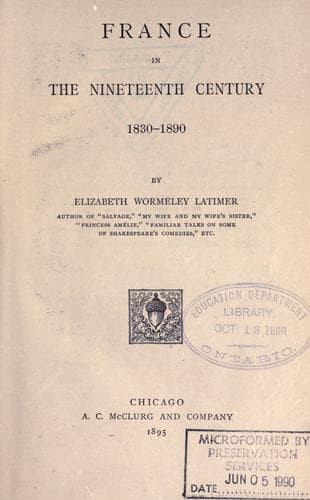
France in the Nineteenth CenturyLatimer, Elizabeth Wormeley
History
France in the Nineteenth Century
Latimer, Elizabeth Wormeley
France -- History -- 1789-1900
When the war was talked about, the emperor spoke of his wish to
go out to the Crimea, and the queen noticed that the empress was
as eager as himself that he should go. "She sees no greater danger
for him _there_," she adds, "than in Paris. She said she was seldom
alarmed for him except when he went out quite alone of a morning....
She is full of courage and spirit, and yet so gentle, with such
innocence and _enjouement_, that the _ensemble_ is most charming.
With all her great liveliness she has the prettiest and most modest
manner."
The queen little guessed what commotion and excitement had gone on
before dinner in the private apartments of the emperor and empress,
when it was discovered that the case containing all the beautiful
toilet prepared for the occasion had not arrived. The emperor suggested
to his wife to retire to rest on the plea of fatigue after the
journey, but she decided to borrow a blue-silk dress from one of
her ladies-in-waiting, in which, with only flowers in her hair,
she increased the queen's impression of her simplicity and modesty.
During the visit the emperor asked the queen where Louis Philippe's
widow, Queen Marie Amélie, was living. She had been at Windsor Castle
only a few days before, and the queen had looked sorrowfully after
her as she drove away, with shabby post-horses, to her residence
near Richmond. The emperor begged her Majesty to express to Louis
Philippe's widow his hope that she would not hesitate to pass through
France on any journey she might make to Spain.
There was a review of the household troops, commanded by Lord Cardigan,
who had led the charge of the Light Brigade at Balaclava, and who
rode the same charger. The emperor rode a fiery, beautiful chestnut,
and his horsemanship was much admired. That evening there was a
State ball at Windsor Castle, and the queen danced a quadrille
with the emperor. The queen wrote that evening in her journal: "How
strange to think that I--the granddaughter of George III.--should
dance with the Emperor Napoleon, nephew of England's greatest enemy,
now my nearest and most intimate ally, in the Waterloo Room, and
that ally living in this country only six years ago in exile, poor
and unthought of!"
She adds, speaking of the empress: "Her manner is the most perfect
thing I have ever seen, so gentle and graceful and kind, and the
courtesy is charming,--so modest and retiring withal."
The next day came a council attended by the emperor, Prince Albert,
ministers, and diplomatists, which lasted so very long that the
queen herself knocked at the door and reminded them that at four
o'clock the emperor was to be invested with the Order of the Garter.
After this ceremony was over, the emperor remarked to the queen
that he had now sworn fidelity to her Majesty, and would carefully
keep his oath.
At dinner that day the talk fell on assassination. The emperor
was shot at by a Carbonaro only a few days after his return from
Windsor, and four years later by Orsini.
Public-domain text, read in full here on John Shaqi.
Reviews
Reviews
No reviews yet
Be the first to share your thoughts on this work.
Elsewhere in the archive
Join the Discussion
Join the discussion
Sign in to leave a comment or review.
Sign InorCreate an account