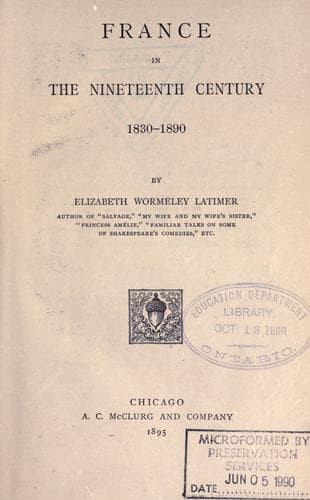
France in the Nineteenth CenturyLatimer, Elizabeth Wormeley
History
France in the Nineteenth Century
Latimer, Elizabeth Wormeley
France -- History -- 1789-1900
"I have been greatly touched to learn that all your family have
shared my joy, and all my hope is that my son may resemble dear
little Prince Arthur, and that he may have the rare qualities of
your children. The sympathy shown on the late occasion by the English
people is another bond between the two countries, and I hope my son
will inherit my feelings of true friendship for the royal family of
England, and of affectionate esteem for the great English nation."
A few months later, the future Emperor Frederick, then recently
engaged to the Princess Royal of England, visited Paris. He was
attended by Major Baron von Moltke, who described the emperor,
empress, and their court in letters to his friends. "The empress,"
he says, "is of astonishing beauty, with a slight, elegant figure,
and dressing with much taste and richness, but without ostentation.
She is very talkative and lively,--much more so than is usual with
persons occupying so high a position. The emperor impressed me
by a sort of immobility of features, and the almost extinguished
look of his eyes."
This look, by the way, was cultivated by the emperor. When his early
playfellow, Madame Cornu, saw him after twelve years' separation,
her first exclamation was: "Why! what have you done to your eyes?"
"The prominent characteristic of the emperor's face," continues
Von Moltke, "is a friendly, good-natured smile which has nothing
Napoleonic about it. He mostly sits quietly with his head on one
side, and events have shown that this tranquillity, which is very
imposing to the restless French nation, is not apathy, but a sign
of a superior mind and a strong will. He is an emperor, and not
a king.... Affairs in France are not in a normal condition, but
it would be difficult to say how, under present circumstances,
they could be improved.... Napoleon III. has nothing of the sombre
sternness of his uncle, neither his imperial demeanor nor his deliberate
attitude. He is a quite simple and somewhat small man, whose always
tranquil countenance gives a strong impression of amiability. He
never gets angry, say the people round him. He is always polite....
He suffers from a want of men of ability to uphold him. He cannot
make use of men of independent character, who insist on having
their own notions, as the direction of affairs of State must be
concentrated in his hands. Greater liberty ought to be conceded in
a regulated state of society, but in the present state of France
there must be a strong and single direction, which is, besides,
best adapted to the French character. Freedom of the Press is for
the present as impossible here as it would be at the headquarters
of an army in the field if the Press wished to discuss the measures
taken by the general in command. Napoleon has shown wisdom, firmness,
self-confidence, but also moderation and clemency; and though simple
in his dress, he does not forget that the French people like to
see their sovereigns surrounded by a brilliant court."
Public-domain text, read in full here on John Shaqi.
Reviews
Reviews
No reviews yet
Be the first to share your thoughts on this work.
Elsewhere in the archive
Join the Discussion
Join the discussion
Sign in to leave a comment or review.
Sign InorCreate an account