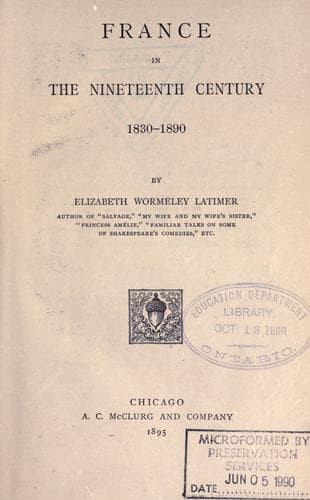
France in the Nineteenth CenturyLatimer, Elizabeth Wormeley
History
France in the Nineteenth Century
Latimer, Elizabeth Wormeley
France -- History -- 1789-1900
When the siege had lasted seventy days, provisions grew so scarce
that the only alternatives seemed a sortie or a surrender. The
sortie was decided on. On the night of May 14, 1867, the seven
thousand men still in Queretaro were to break through the lines of
the enemy and endeavor to make their way to Vera Cruz. Singularly
enough, the Juarist general, Escobedo, had fixed on the 15th of
May for his final assault.
Neither sortie nor assault took place. The treason of General Lopez
prevented the one, and rendered the other unnecessary. Lopez, whom
Maximilian had loaded with all sorts of kindness,--Lopez, who called
himself the most devoted adherent of the emperor,--had sold the
life of his friend and benefactor for two thousand ounces of gold!
One year before, when Lopez had been at Puebla in attendance on
the empress, he had sent for his wife, who, having made a hurried
journey, was prematurely confined. "I cannot allow your son," wrote
Maximilian, "to come into the world in another man's house. I send
you the I enclosed sum. Purchase the house where your son was born."
Having kept up constant communication with the camp of the besiegers,
Lopez, on the morning of May 13, sent a note to Escobedo, offering to
deliver over to him the convent of La Cruz, which was the emperor's
headquarters. Escobedo accepted his proposals. About midnight Lopez
and the troops under his command went over to the enemy. The soldiers
of Juarez quietly entered the town, and surrounded the convent
where the emperor and his staff were sleeping.
At dawn Maximilian rose, dressed himself, woke Prince Salm-Salm,
and they went out together, with no arms but their swords. As they
reached the gates of the convent the emperor perceived Juarist
soldiers on guard, and turning to his companion, cried, "We are
betrayed; here is the enemy!" At this moment Lopez, who had seen
them come into the court-yard, pointed out the emperor to Colonel
Rincon Gallardo, who was in command of the detachment from the army
of Juarez. Rincon was an honorable soldier and kind-hearted. He
said, loud enough to be heard by his own men: "They are citizens;
let them pass: they are not soldiers." The emperor was dressed in
a black frock-coat, but with military trousers and epaulettes.
He and Prince Salm-Salm then walked through the convent gates and
made their way in haste to the opposite quarter of the city. The
streets were silent and empty. Suddenly a sharp fire of musketry
was heard, mingled with Juarist and Imperial war-cries. Miramon
with his troops was holding one of the widest streets of Queretaro,
when a ball hit him in the face. He fell, half blinded, and was
taken prisoner. Miramon was the son of a French father and a Spanish
mother, and was one of the very few generals on either side who
were of pure white blood.
Public-domain text, read in full here on John Shaqi.
Reviews
Reviews
No reviews yet
Be the first to share your thoughts on this work.
Elsewhere in the archive
Join the Discussion
Join the discussion
Sign in to leave a comment or review.
Sign InorCreate an account