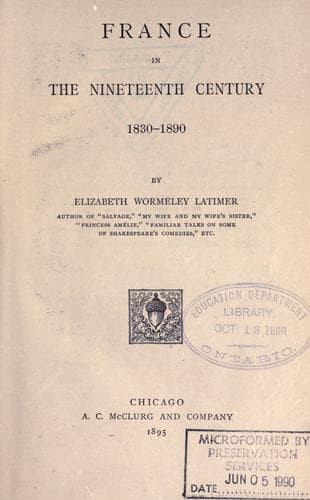
France in the Nineteenth CenturyLatimer, Elizabeth Wormeley
History
France in the Nineteenth Century
Latimer, Elizabeth Wormeley
France -- History -- 1789-1900
The ancient Egyptians, whose attention was much absorbed in waterworks
and means of irrigation, had, as far back as the days of Sesostris,
conceived the idea of communication between the Nile and the Red
Sea. Traces of the canal that they attempted still remain. Pharaoh
Necho, in the days of the Prophet Jeremiah, revived the project.
Darius and one of the Ptolemies completed the work, but when Egypt
sank back into semi-barbarism, the canal was neglected and forgotten.
It does not appear, however, that the Pharaohs ever thought of
connecting the Red Sea with the Mediterranean. The canal of Sesostris
and of Pharaoh Necho was a purely local affair, affecting Egyptian
commerce alone.
Some modern Egyptian engineers seem first to have conceived the
project of a Suez canal; but the man who accomplished it was the
engineer and statesman, M. de Lesseps. In spite of all manner of
discouragements, he brought the canal to completion, supported
throughout by the influence and authority of the khedive. The first
thing to be done was to supply the laborers and the new town of
Ismaïlia with drinking water, by means of a narrow freshwater canal
from the Nile. Till then all fresh water had been brought in tanks
from Cairo. Next, a town--called Port Saïd, after the khedive who had
first favored the plan of the canal--was built on the Mediterranean.
The canal was to run a straight southerly course to Suez. At Ismaïlia,
the new city, it would connect with the railroad to Cairo; between
Port Saïd and Ismaïlia it would pass through two swampy lakes.
In seven years Port Saïd became a town of ten thousand inhabitants.
The total length of the canal is about ninety miles, but more than
half of it passes through the lakes, which had to be dredged. The
width of the canal is a little over one hundred yards, its depth
twenty-six feet. About sixty millions of dollars were expended on
its construction and the preliminary works that it entailed,--these
last all tending to the benefit and prosperity of Egypt.
The grand opening took place Nov. 16, 1869. The sultan was not
present; he had been persuaded out of his fancy to see the sight,
and the khedive was left in peace as master of ceremonies. The
Emperor Francis Joseph of Austria was there in his yacht, and the
Empress Eugénie, the "bright particular star" of the occasion, was
on board the French war-steamer "L'Aigle." As "L'Aigle" steamed
slowly into the crowded port, all the bands played,--
"Partant pour la Syrie,
Le brave et jeune Dunois,"
the air of which had been composed by Queen Hortense, the mother
of the emperor, so that it was dignified during his reign into
a national air.
Public-domain text, read in full here on John Shaqi.
Reviews
Reviews
No reviews yet
Be the first to share your thoughts on this work.
Elsewhere in the archive
Join the Discussion
Join the discussion
Sign in to leave a comment or review.
Sign InorCreate an account