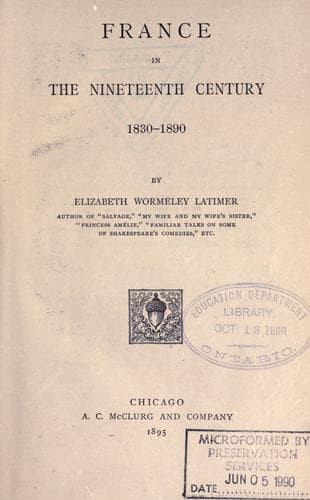
France in the Nineteenth CenturyLatimer, Elizabeth Wormeley
History
France in the Nineteenth Century
Latimer, Elizabeth Wormeley
France -- History -- 1789-1900
"There were cuirassiers," he says, "without cuirasses, fusileers
without guns, horsemen on foot, and infantry on horseback. The
roads taken by the army in its flight were blocked by trains of
wagons loaded with provisions and clothing, and the woods were
filled with stragglers wandering about in a purposeless way. Among
the spoils of that day which fell into the hands of the Prussians
were several railroad freight-cars loaded with Paris confectionery:
and two days after the battle it was easier to obtain a hundredweight
of bonbons at Forbach than a loaf of bread."
All this happened in one week, from August 2 to August 6. During
this week the emperor stayed at Metz, having been implored by his
generals to keep away from the army.
A week later, Strasburg was besieged. MacMahon, the remnants of
whose corps had been driven out of Alsace by the Crown Prince, was
endeavoring to effect a juncture with the army corps of De Failly.
The object of the emperor and Marshal MacMahon was to concentrate
as large a force as possible before the very strongly fortified
city of Metz. But as soon as they reached Metz the armies of General
Steinmetz and Prince Frederic Charles, two hundred and fifty thousand
strong, began to close in upon them. There seemed no safety but
in further retreat. The emperor wanted to give up Lorraine, and
to concentrate all his forces in an intrenched camp at Châlons;
but advices from Paris warned him that a revolt would break out
in the capital if he did so. He therefore resigned his position
as commander-in-chief to Marshal Bazaine. He was coldly received
in the camp at Châlons, and his presence with several thousand
men as a body-guard was an impediment to military operations. He
was therefore virtually dropped out of the army, and from August
18, when this news was known in Paris, his authority in France
was practically at an end. On the same day (August 18) Bazaine's
army was driven into Metz after the battle of Gravelotte, at which
battle the French, though defeated, distinguished themselves by
their bravery. Bazaine had one hundred and seventy thousand men
with him when he retired behind the walls of Metz. Here he was
closely besieged till October 27, when he surrendered.
Public-domain text, read in full here on John Shaqi.
Reviews
Reviews
No reviews yet
Be the first to share your thoughts on this work.
Elsewhere in the archive
Join the Discussion
Join the discussion
Sign in to leave a comment or review.
Sign InorCreate an account